University Southern California Trojans
Players Mentioned
Q&A with Assistant Coach Michael Musselman
June 18, 2026 | Men's Basketball
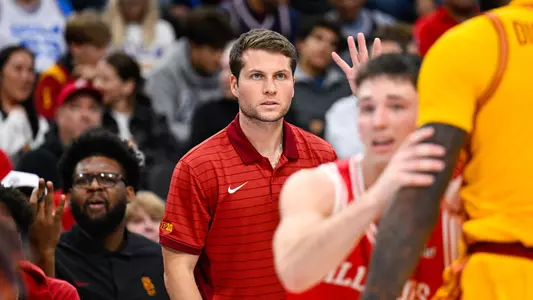
LOS ANGELES — With a talented mix of returners, transfers and blue-chip freshman recruits, the USC Men's Basketball team is looking to make the NCAA Tournament in Head Coach Eric Musselman's third year. Assistant Coach Michael Musselman, who is entering his third season on staff with the Trojans, sat down to share his experience being a young coach, carrying on the Musselman coaching legacy and his thoughts about the team.
You just turned 30 this year. What has the last decade of being in coaching taught you and how have you developed as a man?
The sport of basketball has just taught me so much. As I get older, I reflect on growing up around the game — even from when I was even younger growing up in it — and the principles it teaches: The dedication to a craft, whatever craft that may be, the attention to detail and communication. You can take so much from the game of basketball and from sports in general. Doing the little things is super important to me, and so is staying organized. Trying to bring effort, energy, and enthusiasm like Coach Musselman talks about all the time — not only when you're on the floor, but also when you're in the weight room and when you're in public representing the entity that you work for, or your family, or your last name. Everyday life mirrors the sport of basketball for me in so many ways.
You're the third generation of Musselman men working in coaching. What's your relationship been like working with your father and how have you learned to navigate that?
Navigating it has been pretty easy. He's been coaching my whole life. I've grown up around it. He coached with his dad in the NBA for the Minnesota Timberwolves, and I was around while my grandpa was still coaching. It hasn't been difficult to navigate the personal from the business with my dad.
At work it's all business. Obviously, it spills over into our personal lives. We're working seven days a week and you don't have a set amount of hours in this profession. It's been amazing to go on the road recruiting and sit and watch games with my dad and my brother, who's also getting into the industry. I think this job in this profession takes people away from their families so much, so to be able to work my dad is a unique situation.
What would you say to a young person trying to get into coaching right now, and what would you want them to focus on to succeed?
Find your niche and bring value in that one thing. Whether it's on-floor player development, being really good in practice, film study or even something like learning Photoshop or AI where you can bring value in this specific area while also being able to do everything else.
I'm the analytics guy and I take pride in it. It's something I enjoy. What I'm bringing to this staff is I can look at the sport through an analytical lens, then I can translate those numbers to the rest of the staff of what these numbers mean and how it affects our program. But I'm not so focused on analytics that I can't do an on-floor workout.
Being organized is super important, not just in your area but in recruiting and staff meetings. You have to be organized with what you're going to say in front of the team because every time you stand in front of the team, it's an audition. You're either earning or losing respect from your players, so anytime you go up there, be prepared, have what you want to say memorized and focus on your delivery whenever you talk to the team.
College basketball has become increasingly analytical, especially when it comes to the NCAA Tournament and rankings. How have you seen analytics in basketball change over your time in coaching?
It's changed quite a bit. I've only been in coaching for almost a decade now, and there's been a ton of changes. Analytics have also crept in the NBA a lot over even the last like 10 or 20 years. Coach Musselman has been coaching since he was 22 years old and he pulls a lot from my grandfather, who was a really old-school guy. So it's become a balancing act of using analytics, but not overwhelming the staff and the players with numbers.
For me, the question is how do I blend viewing the sport from an analytical perspective with the old-school defense or offense mentality of a staff. We want to use numbers, but it's not everything to us. For instance, we want to take more threes, but we don't want to take bad threes. So I try to work in numbers where I think they can help without overwhelming people.
Even though basketball isn't played on a spreadsheet and people talk about basketball with so many numbers now, it sounds like the ability to communicate numbers to 18 to 22-year-olds is the key.
For sure. You look at the Spurs NBA Finals games, for instance. The 3-point shot is so emphasized and it's the best shot on paper that you can get besides a free throw. There's a time and a place for it, right? Like if you've missed six threes or if you have a big lead, maybe you want to take a three later in the shot clock. A lot of people try to avoid the last five seconds of the shot clock, but maybe if you're up, you want to bleed all that clock. And so now you're starting to look at the flow of the game, who's in game and who's available that night. Numbers just don't tell the whole picture.
It's a balancing act for sure. And some nights, you want to use analytics more, and some nights you look at all the numbers after the game and you don't know how we won or lost this game because on paper, the stats won't always say a team won or lost a game.
Who do you draw inspiration from, coaching-wise, and which teams do you think do it the right way?
The NBA is like a copycat league. So if a young team wins a title, then everyone goes young. A team takes a lot of threes, then more teams take threes. If someone hires a coach from overseas or if a team has a lot of overseas guys, you'll see a lot more people from overseas come into the league.
I have great respect for Steve Kerr and the Golden State Warriors' ownership and organization. So at USC, we try to take little things from them — they have a pass-per-game stat that we use. I have a great respect for the entire NBA and the coaching profession. But the key is to work those principles and analytical goals into our system where they fit.
Pulling from NBA drills and terminology is a big thing for us. We pride ourselves on getting guys prepared for the NBA, not just making it, but really preparing them so they can stick in the league. The only way to really do that is to run an NBA-style offense, use NBA terminology and NBA drills, so that when they do get there, they're prepared for it.
Speaking of the NBA, Jacob Cofie had a pretty transformative experience at the G-League and NBA Combines this year. What did you see from him when you watched him at the NBA Combine and how have you seen his confidence grow from when you recruited him?
The NBA draft process was a huge confidence boost, especially being called up from the G League Combine to the NBA Combine.He's always had a great personality, but I think he really got a huge boost in confidence in knowing that he belongs there and he can do it with the best of these guys. These guys are still young guys, so seeing him mature as a player and as a person has been rewarding. He was already mature, but now he's growing into an elite basketball player and elite man off the floor. We're super excited that he got that experience and that he's coming to the gym even hungrier. Some guys will go to the combine and think they don't need to keep trying. But he came back and he's working harder. He's in the gym more, getting up more shots on his own. He's getting extra lifts in. So seeing a guy who goes through that experience, gets that confidence, and comes back with the right mindset is big time.
You guys are trying to find your identity between the three newcomers and the 10 newcomers. Where do you think the team is headed and what are some of the traits that stand out about the newcomers so far?
I think we have a very talented team this year — it's probably the most talented team we've had since we've been here. With that comes depth. Now we can play kind of a different style of basketball — we can play more uptempo and we should be a better three-point shooting team. I have a feeling we're going to be better at shooting threes than we're projected to. Being able to play a more aggressive style on both ends of the floor should be super exciting.
Bringing energy every single game will help us put an exciting product out on the floor, which is the most important thing for us. Fans are spending their hard earned money and time to come watch games, so we want those fans to leave saying "I have to come back and see that team."
The roster has 10 newcomers, including seven transfers. Who stands out to you?
They all bring a different skillset. Isaac Bruns, for instance, is an elite shot maker, and we're seeing him rattle off five or six threes in a row when we're in live play. Jalen Cox has great IQ and defensive anticipation. Having a high steal, high assist, guy like him who can be a facilitator and bother the ball defensively brings us a super unique skill set that we haven't really had in the past two years. Jadis Jones is a tough rebounder who should help us run the floor and push the pace while guarding 1-through-4. He's tough, he's physical and he does a little bit of everything for us. KJ Lewis should be one of the better defenders in the Big Ten. He has the shotmaking ability and he's played in great leagues in hostile road environments, plus he has the ability to be a leader for us. He's got a great personality and he's got a big voice in the locker room, which will make him able to earn that respect from his teammates.
The team also has three McDonald's All-Americans on the roster. How have you seen them adapt to college basketball so far?
We love to have a homegrown talent, and Christian Collins is a super special player. We spent a lot of time recruiting him and getting to know him and his family, so it was a special recruitment for us. But then on top of that, he's an extremely good athlete. He has a great story and he's a great person off the floor. On the floor, he's explosive, athletic and fun to watch. He does stuff in the gym that you don't see very often. He can make shots all over the floor and he's a threat on the offensive or defensive end at all times just because he's so versatile. He should be a super exciting guy to watch.
With the Ratliff twins, it's not very often that you see two 7-footers walk in the gym who can make threes at the rate that they can make, block shots, and flly around on defense. They're gonna be super exciting. Between the three of them we should have the tallest team in America. That length with that versatility and — if they don't go pro — the ability to develop them for multiple years was something we focused on as a staff.
Who do you think is poised for a breakout year and who do you think the fans are going to gravitate towards?
Eric Reibe is probably poised for a breakout year when you look at the stat projections and when he has a bit more freedom to shoot threes more often. When he adds that piece to his game, which we've seen in practice, he's poised for a huge year.