University Southern California Trojans
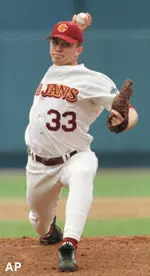
Baseball Looks Back at National Title Run
June 21, 1999 | Baseball
June 26, 1998
It may be cliche to call anything a "team of destiny," but consider the facts for the 1998 USC baseball team, which captured an unprecedented 12th NCAA championship on June 6:
It was the 50th anniversary of USC's first-ever baseball crown, won in 1948;
USC has a near-monopoly on years ending in eight, winning titles in 1948, 1958, 1968, 1978 and now, 1998;
In 1948, USC won in baseball, Kentucky won in men's basketball and Michigan won in ice hockey, all for the first time. Fifty years later, Kentucky and Michigan won their respective titles early in the spring, so it was USC's turn a couple of months later.
But if you don't believe in fate, you had to believe in USC's talent, which featured an extraordinary group of players under the leadership of head coach Mike Gillespie.
Looking back, the turning point of USC's season may not have even come during the season. It may have been during the summer of 1997, when righthanded pitcher Seth Etherton was selected by the St. Louis Cardinals in the ninth round of the professional draft. Negotiations turned bad, and Etherton, to the surprise of everyone, elected to return for his senior year.
Etherton was nothing short of marvelous in 1998, earning The Sporting News' National Player of the Year honors while going 13-3 with a 3.23 ERA. He set Pac-10 single-season (182) and career (420) records for strikeouts in the process. He also led the nation in strikeouts.
Without Etherton picking up a win nearly every Friday night, USC's season surely would have ended much sooner than it did.
Finishing many of Etherton's games was senior righthander Jack Krawczyk, the best reliever in NCAA history, as he set records for saves in a season (23) and career (49). Not a closer in the traditional sense, Krawczyk relied on a sneaky change-up and pinpoint control to get batters out.
Besides Etherton and Krawczyk, two other players earned All-American honors: sophomore catcher Eric Munson (.392, 16 home runs) earned second team notice despite missing 19 games due to injury; and senior third baseman Morgan Ensberg (21 home runs, 20 stolen bases), who made the third team and became the first 20-20 player in USC history.
1998 REGULAR SEASON
The Trojans were ranked No. 5 or 6 in the preseason polls and began the 1998 season accordingly, winning 27 of their first 32 games, including three-game sweeps of future NCAA Tournament teams Long Beach State, North Carolina and Arizona State.
Etherton began to earn national notice for his beginning in particular. Through nine starts, he was 8-0 with a 2.44 ERA.
USC was ranked No. 2 in the country on March 30, heading into a big week against Cal State Fullerton and top-ranked Stanford. Little went right for the Trojans, however, as they fell to the Titans, 7-4, and lost two out of three to the Cardinal.
One of those losses was called the "game of the year" by several national publications. On April 3, Etherton and Stanford's Jeff Austin were both phenomenal and had shutouts going into the seventh inning. But in the top of the seventh, on perhaps the only bad pitch of the night, the Cardinal got a solo home run off of Etherton for the game's only run. Despite striking out a career-high 15 batters and giving up only four hits and no walks in a complete game, Etherton was on the wrong end of a 1-0 score.
To make matters worse, sophomore catcher Eric Munson, a preseason consensus All-American first teamer, had been hobbled by a bad foot. After the Trojans defeated Hawai'i Hilo on April 6, he was diagnosed with a stress fracture in his right foot and would miss nearly all of the remainder of the regular season. At the same time, senior catcher Jeff DePippo was out with torn cartilage in his rib area as the result of an off-the-field accident.
That meant the Trojans would be going to Arizona State for three games without any experienced catchers. USC continued to struggle, dropping all three games to the Sun Devils, then a midweek game to Loyola Marymount. USC had lost seven of its last nine games and was falling in the rankings.
DePippo was back behind the plate for a three-game series against California, though it would be Etherton (who else?) that turned USC's fortunes around. In the first game of the series against the Golden Bears on April 17, the righthander turned in one of his best outings of the season, pitching a no-hitter for 7 2/3 innings en route to an eight-inning, one-hit, 11-strikeout performance in a 10-0 victory.
USC swept Cal that weekend and began winning again. In one memorable game, the Trojans belted a school-record seven home runs, led by three from senior third baseman Morgan Ensberg, in a 17-10 victory against San Diego State on April 21. In that game, USC set a school record for home runs in a season (the old record was 85 in 1984, the Trojans ended up with 114).
The Trojans trailed Stanford in the Pacific-10 Conference Southern Division standings for most of the season, but still had a chance to catch the Cardinal in the end. In the last weekend of Six-Pac play, the Trojans needed a three-game sweep in Palo Alto to win the title.
It didn't happen, however, as Etherton and Austin met again in the first game and Stanford again came away with a victory, 4-2, and the Six-Pac crown. But the Trojans came back thanks to strong performances by freshman righthander Rik Currier and junior righthander Mike Penney to win the next two games. That earned USC a split of the season series with Stanford, and it was the first time all season that the then-top-ranked Cardinal had lost back-to-back games and lost a weekend series.
That effort helped propel USC, which had won 11 of its final 14 regular-season games, into the postseason.
EAST REGIONAL
The Trojans were sent to Clemson, S.C., for the East Regional of the NCAA Tournament, but as the top seed ahead of the host Tigers. USC fought off a scrappy Fordham team, 10-6, in the first round, but got pounded by Virginia Commonwealth, 14-4, in the second round. USC was one loss away from having its season end.
Though USC was second-guessed for not pitching Etherton in the first two games, the move paid off as he started against Clemson on Saturday morning and struck out a career-high-tying 15 in an 8-5 victory. Later that night, the Trojans came back to beat South Alabama, 3-2, as Ensberg had a two-run double in the first inning and junior lefthander Jason Lane pitched 3 1/3 scoreless innings in relief to get the win.
That put USC back into the driver's seat, as South Alabama had to beat VCU on Sunday morning for the right to play the Trojans again in the championship that night. In the finale, Lane started on zero days rest and picked up the win again, while Krawczyk went a season-long 3 2/3 innings for the save.
Munson, who had missed 16 games with his stress fracture, didn't return until the final two games of the regular season against Portland State. At the East Regional, he swung the bat like he hadn't missed any time at all, earning MVP honors after hitting .556 (10-for-18) with two home runs and eight RBI.
USC was going back to Omaha, Neb., for the College World Series for the second time in four years.
COLLEGE WORLD SERIES
When the CWS bracket came out, it looked a lot like USC had been invited to the Southeastern Conference tournament. In addition to top-seeded Florida and eighth-seeded Mississippi State, the fourth-seeded Trojans would take on fifth-seeded (and two-time defending national champion) LSU.
The clash with the Tigers would take place on Saturday, May 30, in front of a national television audience on CBS. The Trojans showed they were ready to play, surprising the Tigers by taking an early 3-0 lead.
But disaster struck, as the combination of Rosenblatt Stadium's small dimensions, a strong wind blowing out and LSU's big bats led to a CWS-record eight home runs by the Tigers, all in a span of four innings. Six of the eight homers came off of Etherton, who struck out 10 in six innings and had a no decision.
The eight home runs led to 10 Tiger runs and the last homer tied the game, 10-10, in the eighth inning. LSU's style of play was dubbed "Gorilla Ball," but the Tigers ended up scoring the winning run not on a home run, but instead on a bloop single to center field that scored two runs in the eighth inning.
As was the case at the East Regional, USC was one loss away from elimination. Plus, it had been nearly 20 years since a team had lost its first game and came back to win the CWS.
The Trojans' next game, on June 1, was against Florida, a surprise loser to Mississippi State. The game went back and forth, but a rare blown save by Krawczyk sent the game into extra innings, tied at 8-8.
Then, the most pivotal pitch of the season took place. The Gators had runners on first and second with two out in the 10th inning, with All-American Brad Wilkerson at the plate. Gillespie made the unorthodox move of intentionally walking Wilkerson to load the bases and put the winning run 90 feet from home plate.
Florida's Casey Smith worked the count against Krawczyk to 3-2, with Troy's season hanging in the balance of the next pitch. Smith swung at a change-up low in the strike zone and dribbled it back to Krawczyk, who got the third out.
In the top of the 11th, USC scored four runs as senior outfielder Jeremy Freitas and freshman outfielder Rod Perry Jr. each drove in two runs with singles and the Trojans went on to win, 12-10.
For the next three games, Trojan pitching dominated. Currier struck out 12 in eight innings to beat Mississippi State, 7-1, on June 2. Junior outfielder Brad Ticehurst hit a pair of solo home runs. That set up a rematch with LSU, though the Trojans would have to win twice in two days to advance to the national championship game.
Etherton, who had been drafted in the first round (18th overall) by the Anaheim Angels earlier in the week, got the call again against LSU on June 4. The first team All-American was determined not to have another bad outing against the Tigers, and he came through with 10 strikeouts in eight innings, allowing only six hits and three runs in a 5-4 win. Krawczyk, also named an All-American first teamer the week of the CWS, pitched the ninth to get the save.
The two teams met again a day later, and this time it was Penney who shut down the Tigers. He went 7 2/3 innings, giving up eight hits and three runs while striking out five in a 7-3 victory. Lane, who was having a tremendous CWS at the plate, hit two home runs.
Gorilla Ball had given way to the Trojans' pitching, hitting and defense. So after playing five games in seven days, the Trojans were back in familiar territory: playing for the NCAA championship.
THE CHAMPIONSHIP GAME
And it would be a familiar foe for the Trojans: Pac-10 rival Arizona State. The two teams had met three times previously in the championship game, with USC winning all three. But in 1998, the schools had split their six meetings.
To say that the championship game was incredible would be an understatement. Dozens and dozens of records were set or tied as the Trojans posted a 21-14 victory, a score more in line with the Trojan-Sun Devil football series.
The Trojans never trailed, but even with several big leads, it wasn't until the ninth inning that they were totally in command. The game started very well for the Trojans, as senior second baseman Wes Rachels singled, junior outfielder Greg Hanoian walked and junior first baseman Robb Gorr slugged a three-run home run. USC scored five more runs in the top of the second as Rachels hit a three-run home run and Gorr knocked a solo shot to make it 8-0.
The Sun Devils didn't go away, scoring five runs of their own in the bottom of the second and pulling within one run, 9-8, after four innings.
USC took an 11-8 lead going to the top of the seventh. Like the Florida game, another huge moment took place. Ensberg danced down the third-base line three times, bluffing like he was going to steal home. On a 1-2 count, Ensberg ran down the line again ... and kept going. He slid safely, just under the tag, for a rare steal of home. Rachels followed with a two-run single to make it 14-8. It was Rachels' fifth hit of the day with a championship-game record-setting seven RBI.
ASU came back again, however, scoring five runs in the bottom of the seventh to pull within one run at 14-13. The importance of Ensberg's steal became very obvious. If he was tagged out, or if the pitch was a strike, USC wouldn't have scored any runs and the Sun Devils would have taken a 13-11 lead after their at-bat.
Instead, the Trojans increased their lead to 16-13 on a two-run home run by Ticehurst (who was hitless in his last 10 at-bats) in the top of the eighth. It went back to a two-run game after the Sun Devils added a solo home run in the bottom of the eighth, but Krawczyk came in to get the final two outs.
In the top of the ninth, USC finally put the game out of reach, scoring five times to make it 21-14 as Ensberg had an RBI double and Lane slugged a grand slam over the centerfield wall. It capped off an amazing series for Lane, who set CWS records for hits (15) and total bases (31) with an overall average of .517.
There's no way that Krawczyk was going to let ASU back into the game and he pitched a 1-2-3 ninth, getting the final out on a fly ball that settled into senior Jeff DePippo's glove in left field. Fittingly, Krawczyk set the NCAA records for single-season and career saves in the championship game.
Rachels was named Most Outstanding Player after his solid defense and record-setting championship-game performance. He was joined on the All-College World Series team by Munson, Gorr, Ticehurst, Lane and Krawczyk.
Among the CWS records set by USC were home runs (17), batting average (.378), runs (62) and hits (88).
But the most important record was one that USC already held and extended this season: a 12th national championship, more than twice as many as any other school, and furthering Troy's reputation as the Team of the Century.
-- By Roger Horne, USC Assistant Sports Information Director