University Southern California Trojans



Players Mentioned

Sprints
/ Track & Field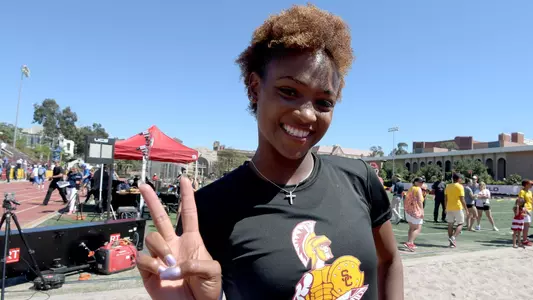
Photo by: Kirby Lee
Getting To Know Deanna Hill
October 17, 2017 | Track & Field, Features
Senior All-American Deanna Hill begins her final season with USC competing in the sprints and relays. She ranks in USC's all-time top 10 in the 100m and 200m dashes and has run on USC's school-record setting 4x100m and 4x400m relays. Last season, Hill earned first-team All-America honors outdoors in the 200m and 4x400m relay. Indoors, she earned All-America honors on USC's collegiate record-setting 4x400m relay team, which won the NCAA title and in the 200m dash, as she placed third with a school-record time. Read below to get Hill's thoughts on her journey as a Trojan.
Q: What is your favorite part about USC?
DH: Coming from Florida to L.A. was a new environment, but it was similar in terms of pace. I think a lot of people have issues going to college in the city, but I always think it's something that is a pro. You're able to be on campus and have many things going on there, and also go off campus and actually experience other aspects of life while you're still in college. You get to have the experience, while not being in the real world, so you get to have a little bit of both. A lot of times when you go to a college that's in the middle of nowhere, all you have is college life and then when you go into the real world it's like "Woah!" Being able to juggle those two and get a little bit of the real world with college life is a pro for me.
Q: What is your favorite part about USC's track and field team?
DH: Everyone sees it as a big school. Everyone thinks you must have a big campus? You must have a lot of people on your team? So I think for me, having that presence, but really being a small team is the biggest thing for me. When we walk into a room, there's about 35 of us but the fact that people see a whole army of 50 people. Including the men's team, we have about 70, so being able to have that presence is a plus. We're so close. On the weekends or weekdays whenever we're bored, we all gather together at one place, even away from the track. Being able to have that relationship with them on and off the track, it brings a chemistry to the track meet. A lot of times, teams split up and you can't talk to anybody else other than the people you train with. But being able to go into a different event, I talk to jumpers, I talk to the throwers. Even after you graduate, we have a lot of alumni that we still hang out with. Coming in, they were seniors and I still hang out with them. I have one [an alum] from last year, a thrower, that comes over and we do Sunday dinners still. So having that family relationship, it comforts you while you're still here and it comes with you when you graduate.
Q: What made you interested in attending SC and joining the track team?
DH: I grew up not really having a favorite college or dream school, which I guess is a pro and a con. When you have a dream school, sometimes when you don't get in it's devastating, but not having a dream school when I was ready to pick a college, I was like I don't know. I knew I wanted to go somewhere with good weather, so I put out all my schools and had a list of what I wanted from the school. I wanted to go to a school within a large city. I knew Coach Caryl from when she trained in Florida. So I enjoyed her as a person and knew how she was strict, but kept it real with you. I didn't like coaches that just told me whatever I wanted to hear. From the top, I wasn't even committed here and she was just telling me the truth. I was thinking, "Wow you're really bold." I like that about her and it was an opportunity to come live in L.A. Everybody wants to try out L.A., so the fact that I could come to L.A. and be able to decide after four years if I want to stay or go, without having to fully commit, was a big pro for me too.
Q: What is the toughest part about being a student athlete and how do you balance that having a social life?
DH: One of the things you hear from everybody is that academics here are very difficult. I'm a Human Bio major, so that major alone is already hard, without having to wake up as early as I do. I wake up early for practice. three days out of the week during the fall. I have 8 a.m. classes and classes that end at 6 p.m. So being able to do all of that, and train in the middle is a challenge. Then along with that, still have to keep up with nutrition.
I think the biggest thing is that I had to learn was time management because at the end of the day, it's possible. Then you have to live up to an expectation that other people may not have to. A lot of times you get the stereotype of that all we're here for is sports. I have to hear that all the time, "Oh I don't do this I don't do that" so I like being able to prove that wrong. I try to get the best grades in the class. I try to be the teachers' favorite student because sometimes you come into a classroom and you're already below everybody else just in perception. You have to work harder in the classroom to be able to be just as good as somebody else in the classroom, just because people think athletes don't care about the academic side which is false.
Q: What about USC and the track team has helped you in your personal life beyond school?
DH: I think more than just running track and going out, I think it helped me to have really close relationships. Growing up, I moved around a lot. I'd have really good friends and then once I moved, they disappeared. Then I'd have new good friends and then they'd disappear. Having to keep changing new friends is a lot. But coming here and being with these people, training with my teammates, out there on the track, in the cold, and the hot, and when its chilly, just working out there with them, has helped me to understand relationships. It has helped me to take the leap and actually get closer to people, being able to tell people things I'd never been able to tell others before and having relationships with more than just my family. I'm really close to my family, but besides my family, not many people knew everything about me. Finding those close relationships is something I learned about life. Once I graduate, I will still have those relationships and not have to transfer over to the new friends.
Q: What are some of your personal and team goals for the upcoming season?
DH: This is my last year, and like any other college athlete, I want to go to the next level. I want to become a pro, get a contract, run for the Team USA, run overseas, be able to experience the world and also get to do what I love. To do that, I have to come in and have a really good college season. I want to start really strong with indoors and then make sure I finish strong during the outdoor season. As a team, for the relays, each year we're always so close. We won indoors last year (relay), but then got second in outdoors. For relays, coming out there and being strong and cohesive will be important. Then for the team overall, just putting the pieces together. For track, it's just so hard to get a great overall team because you have so many different types of people you're trying to put together for one goal. Having every aspect of our team, every event come together and try to get that goal will be key. I think going into Nationals each year, indoor and outdoor, we generally have fewer people than the other teams, so bringing more people to Nationals would help us achieve our goal. The goal is the win Nationals. The way to get there, I feel, is having more people at Nationals to score.
Q: How do you stay focused before and during your competitions?
DH: Everyone is a little different. You have the serious people. You have the super goofy people. I'm the goofier one. You'll catch me always dancing. It's not that I'm not focused or I'm not taking it serious, it's just that I'm that person that if I think too much about it, when I get there, my mind is way off. Coming in, I used to be super serious, just listening to my music by myself all the time. But, I realized I will be going over the races over and over and over, so by the time I got to the race, I was tired. I didn't even do anything yet, I'm warming up and I'm like 'Man I am super tired' because I have mentally brought my body through that thing so many times. Now, I have music, I sing along to everything. I can't sing for nothing, but I will hit every high note I can hit and I don't care whose around. So being able to keep my mind off of it, but still able to stay focused within the competition. We warm up about an hour before we compete and that hour is my time to start thinking about everything and getting focused. I think everyone has to find their time for when they need to get serious. Some people like it right when they wake up they have to be serious. For me, I have to keep my mind off things and start thinking about just nothing. Thinking about music is like thinking about nothing to me. It always gets me into the music world and just seeing lyrics at that time. Not thinking about life, not thinking about school not thinking about social life, track, nothing. It just the music. I just get to the beat and just ride it on out.
Q: Who is your biggest inspiration?
DH: I'm really close to my family. I had a sister who is six years older than me so that was like my other mother in a sense. When I'd ask my parents for something, they'd say "Go ask your sister to take you." So growing up I don't think she understands how much of a big inspiration she was for me. I always tried to do what she wanted to do and it was annoying to her, but it was just because I wanted to be like her. Once I started getting into track, I started to look up to Allyson Felix. My favorite event would be the 200, it's ] that middle piece from the 4 and the 1. I saw her coming up and the 200 was the biggest thing for her. Everyone always ask me am I a 1 or a 4? Are you a short sprinter or a long sprinter? Yes I can do both, but that doesn't make me one or the other, so I felt like she was a good role model to look up to and say hey I can do both. I don't just have to be a short sprinter. I don't just have to be a long sprinter. I'm just a sprinter. If I just focus and work hard that I can prove I'm all types of sprinters.
Q: What have you learned from being a student athlete from USC and the track team that you will carry into life after sports?
DH: I think for me being a student athlete, time management and putting the priorities in line. Throughout all four years I can't say that I've always had my priorities straight. One thing I told my team this year, in one of our first meetings and one of the things we've worked on, was me being selfish. Everyone sees selfishness as a bad thing, but in some cases you have to be selfish. You have to be able to put yourself in front of other people because at the end of the day, everybody is looking out for their own. A lot of the times I'm here to help out everybody else and then my own goals fall down. It's not that I'm not focused on my goals, it's not that I don't want my goals, it's just that helping everyone else doesn't give me enough time to focus on myself. This year, it's all about making sure that other issues don't affect me and what I have going on. This is my last year. After this, it's the real world. You can't live the college life your whole life. The faster you get to the real world, the more you understand it and the better you'll do.
Q: What would you say separates USC from other schools?
DH: When you go to different colleges, they tell you all the positives and pros, so when I see a recruit, I start off with its going to be hard. Sometimes at other colleges, college life is all about the fun and the competing. At USC, its hard. You're going to have a lot of "I don't know how I'm going to get to the end of this week" but you figure it out, whether the way you figure it out works your way or not you learn from it. It all correlates to the real world and I think that's what USC brings to this table that most don't. When you get in the real world you're going to be ahead of these other people coming out of college who haven't really had to work for much as much as we've had to work. Everything little thing we do, we have to fight for it and work for it. I think bringing that and the alumni and going to networking dinners. Alumni know what you had to go through to get here. So I think having that behind you. People ask me what am I going to do after college. If I can go pro, then I'll go pro. If not, then I'll get a job, but at the end of the day, I don't feel as stressed as other people at other schools because I know the Trojan family has my back. I know I've worked hard throughout the years, I understand what I need to do and I know there are going to be people who have my back after all of it.
Q: What is your favorite part about USC?
DH: Coming from Florida to L.A. was a new environment, but it was similar in terms of pace. I think a lot of people have issues going to college in the city, but I always think it's something that is a pro. You're able to be on campus and have many things going on there, and also go off campus and actually experience other aspects of life while you're still in college. You get to have the experience, while not being in the real world, so you get to have a little bit of both. A lot of times when you go to a college that's in the middle of nowhere, all you have is college life and then when you go into the real world it's like "Woah!" Being able to juggle those two and get a little bit of the real world with college life is a pro for me.
Q: What is your favorite part about USC's track and field team?
DH: Everyone sees it as a big school. Everyone thinks you must have a big campus? You must have a lot of people on your team? So I think for me, having that presence, but really being a small team is the biggest thing for me. When we walk into a room, there's about 35 of us but the fact that people see a whole army of 50 people. Including the men's team, we have about 70, so being able to have that presence is a plus. We're so close. On the weekends or weekdays whenever we're bored, we all gather together at one place, even away from the track. Being able to have that relationship with them on and off the track, it brings a chemistry to the track meet. A lot of times, teams split up and you can't talk to anybody else other than the people you train with. But being able to go into a different event, I talk to jumpers, I talk to the throwers. Even after you graduate, we have a lot of alumni that we still hang out with. Coming in, they were seniors and I still hang out with them. I have one [an alum] from last year, a thrower, that comes over and we do Sunday dinners still. So having that family relationship, it comforts you while you're still here and it comes with you when you graduate.
Q: What made you interested in attending SC and joining the track team?
DH: I grew up not really having a favorite college or dream school, which I guess is a pro and a con. When you have a dream school, sometimes when you don't get in it's devastating, but not having a dream school when I was ready to pick a college, I was like I don't know. I knew I wanted to go somewhere with good weather, so I put out all my schools and had a list of what I wanted from the school. I wanted to go to a school within a large city. I knew Coach Caryl from when she trained in Florida. So I enjoyed her as a person and knew how she was strict, but kept it real with you. I didn't like coaches that just told me whatever I wanted to hear. From the top, I wasn't even committed here and she was just telling me the truth. I was thinking, "Wow you're really bold." I like that about her and it was an opportunity to come live in L.A. Everybody wants to try out L.A., so the fact that I could come to L.A. and be able to decide after four years if I want to stay or go, without having to fully commit, was a big pro for me too.
Q: What is the toughest part about being a student athlete and how do you balance that having a social life?
DH: One of the things you hear from everybody is that academics here are very difficult. I'm a Human Bio major, so that major alone is already hard, without having to wake up as early as I do. I wake up early for practice. three days out of the week during the fall. I have 8 a.m. classes and classes that end at 6 p.m. So being able to do all of that, and train in the middle is a challenge. Then along with that, still have to keep up with nutrition.
I think the biggest thing is that I had to learn was time management because at the end of the day, it's possible. Then you have to live up to an expectation that other people may not have to. A lot of times you get the stereotype of that all we're here for is sports. I have to hear that all the time, "Oh I don't do this I don't do that" so I like being able to prove that wrong. I try to get the best grades in the class. I try to be the teachers' favorite student because sometimes you come into a classroom and you're already below everybody else just in perception. You have to work harder in the classroom to be able to be just as good as somebody else in the classroom, just because people think athletes don't care about the academic side which is false.
Q: What about USC and the track team has helped you in your personal life beyond school?
DH: I think more than just running track and going out, I think it helped me to have really close relationships. Growing up, I moved around a lot. I'd have really good friends and then once I moved, they disappeared. Then I'd have new good friends and then they'd disappear. Having to keep changing new friends is a lot. But coming here and being with these people, training with my teammates, out there on the track, in the cold, and the hot, and when its chilly, just working out there with them, has helped me to understand relationships. It has helped me to take the leap and actually get closer to people, being able to tell people things I'd never been able to tell others before and having relationships with more than just my family. I'm really close to my family, but besides my family, not many people knew everything about me. Finding those close relationships is something I learned about life. Once I graduate, I will still have those relationships and not have to transfer over to the new friends.
Q: What are some of your personal and team goals for the upcoming season?
DH: This is my last year, and like any other college athlete, I want to go to the next level. I want to become a pro, get a contract, run for the Team USA, run overseas, be able to experience the world and also get to do what I love. To do that, I have to come in and have a really good college season. I want to start really strong with indoors and then make sure I finish strong during the outdoor season. As a team, for the relays, each year we're always so close. We won indoors last year (relay), but then got second in outdoors. For relays, coming out there and being strong and cohesive will be important. Then for the team overall, just putting the pieces together. For track, it's just so hard to get a great overall team because you have so many different types of people you're trying to put together for one goal. Having every aspect of our team, every event come together and try to get that goal will be key. I think going into Nationals each year, indoor and outdoor, we generally have fewer people than the other teams, so bringing more people to Nationals would help us achieve our goal. The goal is the win Nationals. The way to get there, I feel, is having more people at Nationals to score.
Q: How do you stay focused before and during your competitions?
DH: Everyone is a little different. You have the serious people. You have the super goofy people. I'm the goofier one. You'll catch me always dancing. It's not that I'm not focused or I'm not taking it serious, it's just that I'm that person that if I think too much about it, when I get there, my mind is way off. Coming in, I used to be super serious, just listening to my music by myself all the time. But, I realized I will be going over the races over and over and over, so by the time I got to the race, I was tired. I didn't even do anything yet, I'm warming up and I'm like 'Man I am super tired' because I have mentally brought my body through that thing so many times. Now, I have music, I sing along to everything. I can't sing for nothing, but I will hit every high note I can hit and I don't care whose around. So being able to keep my mind off of it, but still able to stay focused within the competition. We warm up about an hour before we compete and that hour is my time to start thinking about everything and getting focused. I think everyone has to find their time for when they need to get serious. Some people like it right when they wake up they have to be serious. For me, I have to keep my mind off things and start thinking about just nothing. Thinking about music is like thinking about nothing to me. It always gets me into the music world and just seeing lyrics at that time. Not thinking about life, not thinking about school not thinking about social life, track, nothing. It just the music. I just get to the beat and just ride it on out.
Q: Who is your biggest inspiration?
DH: I'm really close to my family. I had a sister who is six years older than me so that was like my other mother in a sense. When I'd ask my parents for something, they'd say "Go ask your sister to take you." So growing up I don't think she understands how much of a big inspiration she was for me. I always tried to do what she wanted to do and it was annoying to her, but it was just because I wanted to be like her. Once I started getting into track, I started to look up to Allyson Felix. My favorite event would be the 200, it's ] that middle piece from the 4 and the 1. I saw her coming up and the 200 was the biggest thing for her. Everyone always ask me am I a 1 or a 4? Are you a short sprinter or a long sprinter? Yes I can do both, but that doesn't make me one or the other, so I felt like she was a good role model to look up to and say hey I can do both. I don't just have to be a short sprinter. I don't just have to be a long sprinter. I'm just a sprinter. If I just focus and work hard that I can prove I'm all types of sprinters.
Q: What have you learned from being a student athlete from USC and the track team that you will carry into life after sports?
DH: I think for me being a student athlete, time management and putting the priorities in line. Throughout all four years I can't say that I've always had my priorities straight. One thing I told my team this year, in one of our first meetings and one of the things we've worked on, was me being selfish. Everyone sees selfishness as a bad thing, but in some cases you have to be selfish. You have to be able to put yourself in front of other people because at the end of the day, everybody is looking out for their own. A lot of the times I'm here to help out everybody else and then my own goals fall down. It's not that I'm not focused on my goals, it's not that I don't want my goals, it's just that helping everyone else doesn't give me enough time to focus on myself. This year, it's all about making sure that other issues don't affect me and what I have going on. This is my last year. After this, it's the real world. You can't live the college life your whole life. The faster you get to the real world, the more you understand it and the better you'll do.
Q: What would you say separates USC from other schools?
DH: When you go to different colleges, they tell you all the positives and pros, so when I see a recruit, I start off with its going to be hard. Sometimes at other colleges, college life is all about the fun and the competing. At USC, its hard. You're going to have a lot of "I don't know how I'm going to get to the end of this week" but you figure it out, whether the way you figure it out works your way or not you learn from it. It all correlates to the real world and I think that's what USC brings to this table that most don't. When you get in the real world you're going to be ahead of these other people coming out of college who haven't really had to work for much as much as we've had to work. Everything little thing we do, we have to fight for it and work for it. I think bringing that and the alumni and going to networking dinners. Alumni know what you had to go through to get here. So I think having that behind you. People ask me what am I going to do after college. If I can go pro, then I'll go pro. If not, then I'll get a job, but at the end of the day, I don't feel as stressed as other people at other schools because I know the Trojan family has my back. I know I've worked hard throughout the years, I understand what I need to do and I know there are going to be people who have my back after all of it.
USC Track & Field | Ron and Sharlene Allice Trojan Invitational (Day 2)
Saturday, March 28
USC Track & Field - 2025 NCAA Outdoor Championships: Day 4 Highlights (6/14/25)
Saturday, June 14
USC Track & Field - 2025 NCAA Outdoor Championships: Day 3 Highlights (6/13/25)
Friday, June 13
USC Track & Field - 2025 NCAA Outdoor Championships: Day 2 Highlights (6/12/25)
Thursday, June 12