University Southern California Trojans


Players Mentioned
Throws
/ Track & Field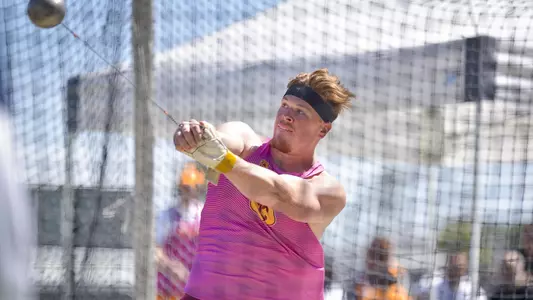
Photo by: John McGillen
Getting To Know Nathan Bultman
April 19, 2018 | Track & Field, Features
Sophomore thrower Nathan Bultman is ready to make his mark for USC after suffering an injury last season which kept him from competing during the outdoor campaign. He has gotten off to a hot start in this season's outdoor campaign, recently setting a PR in the hammer throw with a mark of 213-5 (65.05m) at the Triton Invitational. Before his injury, Bultman made his way onto multiple USC indoor all-time lists. In 2017, he won the shot put at the N.M. classic with a throw that ranks 8th on the all-time indoor list and he placed third in the weight row at the Husky Classic that marks second on the all-time list. He also had a strong freshman outdoor season, placing third in the hammer throw at the Pac-12 Championships. Read below to learn more about how this all-around thrower balances life as a student-athlete, what his goals are for this season and how he learned to throw from his father.
Q: What inspired you to come to USC?
NB: When it came down to it, I did not know I would be able to make it into USC. I first visited when I was a child and I thought everyone here was too smart, but receiving a scholarship offer and realizing that my athletic talents could get me into school here sold me.
Q: You were out for most of last season with an injury. What did you learn from having to overcome that adversity?
NB: I was very bummed. I didn't even think I would have a year to redshirt, but it gave me a lot of time to work on the stuff that I wouldn't have worked on. For example, I got to pick up the hammer a lot more because it didn't bother my wrist as much because I had tendinitis. I worked on a lot of things. We refined the basics and went over what I would not have been able to do if it came down to me competing throughout that season. So, the fundamentals and really ingraining everything, like specific movements that you can't do during the regular season, but you can if you had that extra offseason.
Q: What made you want to compete as a thrower?
NB: My father was originally a thrower and that had a huge influence on me because he saw my size when I was young. I was immediately placed in football, basketball and track. I ended up having too many concussions from football and my dad saw my talents as a thrower. He went to UCLA as a thrower on a full scholarship and taught me everything I know until I came here. It really stemmed from his influence and then once I saw that I could get into college with my talent, that was my main motivation?
Q: How did you take skills from the other sports you played and apply them to throwing?
NB: It's just been growing up and becoming an athlete. My whole entire life I've been an athlete. I always think about how if I don't become a professional athlete, how am I going to cope with that aspect and not being an athlete. It started from when I was younger and I was always competitive with my brothers and cousins and it just became a part of my life through that.
Q: What are some personal goals you want to accomplish this season?
NB: For this season in the hammer, I would like to hit at least 67 meters. In the discus, I'd like to back up my PR, anything over 55 meters in the discus would be greatly appreciated. I would love to be back up in there, but I'm creating this path that will set me up for my senior year and fifth year. It's a slow path, but it definitely takes time and you can't rush through it. That was a big thing that me and Coach Dan Lange worked on in our redshirt year was to take the slow road since we have the extra year to work on it.
Q: What's it like working with Coach Dan Lange who is one of the most accomplished throwing coaches in school history?
NB: Immediately you know that you are in the presence of one of the greatest coaches, if not the greatest, to be coaching throwers. You know he's coached some of the greatest. I'm currently training with Connor McCullough, an Olympian, and coach Dan's level of coaching you can tell that he's even coached guys further than where Connor is at. Just him being comfortable coaching elite athletes and his strong confidence in his abilities makes me feel confident when I go out there and throw. He always has a plan for me and the next step that I should take. It's very humbling to be coached by him.
Q: How have you found a balance as a student-athlete?
NB: It's definitely tough, but like I said earlier I've been doing it my whole life. Once you get to that fifth year of being an athlete and balancing it, it becomes a part of who I am. College is definitely a higher academic load than it was in high school, but it just stems from having your priorities straight. You have to take some time out of being social and put more time into studying at the JMC or take some time away from family even. You have to separate fun from business and know which times are appropriate to work on each.
Q: What separates USC's track & field program from all the other schools?
NB: You're getting the full experience of a good education along with a great athletic program. We are historically the best track and field team in the nation and you're getting that along with a great education. That alone is a huge recruiting tool, but also the community that we have here, being in Los Angeles and the amount of networking opportunities you have through these wonderful athletes that you meet are amazing. I've never been closer to a team before. It's a small team and you're not just talking to your event group, so when you're talking to other people in other events you feel like it's very much like a brotherhood. You have a lot of support from every member of the team.
Q: Do you have any pre-competition rituals?
NB: It kind of varies year by year. I had one where I had to be listening to a specific song before a meet. This year I haven't really had any. I try not to have any because coach Dan has taught us that if we always stick by the same ritual and there's a time when you can't do it, then you'll get in your head. I've learned to refrain from that more and more that I've been under his coaching. It's helped. I don't feel like I have to be doing anything specific before, I'm not superstitious and I feel prepared for every meet.
Q: What inspired you to come to USC?
NB: When it came down to it, I did not know I would be able to make it into USC. I first visited when I was a child and I thought everyone here was too smart, but receiving a scholarship offer and realizing that my athletic talents could get me into school here sold me.
Q: You were out for most of last season with an injury. What did you learn from having to overcome that adversity?
NB: I was very bummed. I didn't even think I would have a year to redshirt, but it gave me a lot of time to work on the stuff that I wouldn't have worked on. For example, I got to pick up the hammer a lot more because it didn't bother my wrist as much because I had tendinitis. I worked on a lot of things. We refined the basics and went over what I would not have been able to do if it came down to me competing throughout that season. So, the fundamentals and really ingraining everything, like specific movements that you can't do during the regular season, but you can if you had that extra offseason.
Q: What made you want to compete as a thrower?
NB: My father was originally a thrower and that had a huge influence on me because he saw my size when I was young. I was immediately placed in football, basketball and track. I ended up having too many concussions from football and my dad saw my talents as a thrower. He went to UCLA as a thrower on a full scholarship and taught me everything I know until I came here. It really stemmed from his influence and then once I saw that I could get into college with my talent, that was my main motivation?
Q: How did you take skills from the other sports you played and apply them to throwing?
NB: It's just been growing up and becoming an athlete. My whole entire life I've been an athlete. I always think about how if I don't become a professional athlete, how am I going to cope with that aspect and not being an athlete. It started from when I was younger and I was always competitive with my brothers and cousins and it just became a part of my life through that.
Q: What are some personal goals you want to accomplish this season?
NB: For this season in the hammer, I would like to hit at least 67 meters. In the discus, I'd like to back up my PR, anything over 55 meters in the discus would be greatly appreciated. I would love to be back up in there, but I'm creating this path that will set me up for my senior year and fifth year. It's a slow path, but it definitely takes time and you can't rush through it. That was a big thing that me and Coach Dan Lange worked on in our redshirt year was to take the slow road since we have the extra year to work on it.
Q: What's it like working with Coach Dan Lange who is one of the most accomplished throwing coaches in school history?
NB: Immediately you know that you are in the presence of one of the greatest coaches, if not the greatest, to be coaching throwers. You know he's coached some of the greatest. I'm currently training with Connor McCullough, an Olympian, and coach Dan's level of coaching you can tell that he's even coached guys further than where Connor is at. Just him being comfortable coaching elite athletes and his strong confidence in his abilities makes me feel confident when I go out there and throw. He always has a plan for me and the next step that I should take. It's very humbling to be coached by him.
Q: How have you found a balance as a student-athlete?
NB: It's definitely tough, but like I said earlier I've been doing it my whole life. Once you get to that fifth year of being an athlete and balancing it, it becomes a part of who I am. College is definitely a higher academic load than it was in high school, but it just stems from having your priorities straight. You have to take some time out of being social and put more time into studying at the JMC or take some time away from family even. You have to separate fun from business and know which times are appropriate to work on each.
Q: What separates USC's track & field program from all the other schools?
NB: You're getting the full experience of a good education along with a great athletic program. We are historically the best track and field team in the nation and you're getting that along with a great education. That alone is a huge recruiting tool, but also the community that we have here, being in Los Angeles and the amount of networking opportunities you have through these wonderful athletes that you meet are amazing. I've never been closer to a team before. It's a small team and you're not just talking to your event group, so when you're talking to other people in other events you feel like it's very much like a brotherhood. You have a lot of support from every member of the team.
Q: Do you have any pre-competition rituals?
NB: It kind of varies year by year. I had one where I had to be listening to a specific song before a meet. This year I haven't really had any. I try not to have any because coach Dan has taught us that if we always stick by the same ritual and there's a time when you can't do it, then you'll get in your head. I've learned to refrain from that more and more that I've been under his coaching. It's helped. I don't feel like I have to be doing anything specific before, I'm not superstitious and I feel prepared for every meet.
Wednesday, June 17
Sunday, May 17
Thursday, May 14
Saturday, March 28