University Southern California Trojans
January 05, 2005 | Football
Jan. 5, 2005
By JIM LITKE
AP Sports Columnist
MIAMI (AP) - Calling this one a statement game doesn't do it justice.
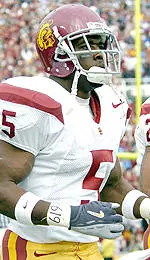
Southern California's devastating 55-19 win Tuesday night over Oklahoma in the Orange Bowl was much more than that. Robbed of a chance to play for the Bowl Championship Series' share of the national title a year ago, the Trojans showed the BCS computers and any remaining doubters just how far off the mark they were.
So let's call this one a statement for the decade, even if we're only at the halfway point.
"This is a program that's flying," coach Pete Carroll said. "There's no doubt about that."
Consider the evidence:
- 22 straight wins and 33 in the last 34 games.
- Second-most points ever scored by a No. 1-ranked team against a No. 2, after Nebraska's 62 off Florida in the 1996 Fiesta Bowl.
- Consecutive Associated Press national championships, the first school to accomplish that since Nebraska in 1994-95.
- The first team to win two national championships of any kind since the calendar turned over a new century.
Oklahoma might have made a like claim, with its 2000 title, consecutive appearances in the BCS championship game, similarly gaudy offensive and defensive stats and even the same number of Heisman Trophy candidates as USC.
Equality on paper, perhaps. Certainly not on the field, where Southern Cal's domination put an exclamation point at the end of its statement.
"I think they're great, but I don't know if that's a surprise to anybody," Oklahoma coach Bob Stoops said. "We felt that way a week ago, and they sure proved it today."
At this time last year, after watching USC humble a very good Michigan team in the Rose Bowl, and then enduring a dreary, four-hour tractor pull of a Sugar Bowl game in which LSU muddled past the Sooners, I wrote: "Southern California could beat these teams - back-to-back - and still make it to the beach in time to catch the sunset."
Turns out that might have underestimated the Trojans, too.
Carroll arrived in Los Angeles in 2001 to find one of college football's traditional powers running on fumes. Carroll was still trying to recover from a case of burnout himself, having been run out of the NFL after unimpressive stints coaching the Jets and Patriots. He and USC needed each other in ways that are only now becoming apparent.
His nice-guy persona and enthusiasm for the game were derided in the pros, but they were a perfect fit in laid-back Southern California. Those same qualities, in a contradictory way, made it easier for Carroll to bring some badly needed NFL-style organization to a program that had stumbled from season to underperforming season without any real plans on how to improve.
He gave his assistants a wide berth and his players the chance to play immediately. That willingness to experiment only got him mocked in the hidebound NFL. But at USC, spreading around the responsibilities - and the credit - brought out the best in just about everybody.
It didn't hurt, of course, that Carroll was a genius at recruiting and was able to find the talent he needed to play the wide-open offense run by mad scientist Norm Chow and the aggressive defense that is his own specialty. Think of some of the players who have already come and gone during Carroll's tenure - quarterback Carson Palmer, receiver Mike Williams and safety Troy Polamalu - and the only reason they're not missed even more is because of how quickly they were replaced by guys like Matt Leinart, Reggie Bush and Shaun Cody.
Even so, those spinning, diving, one-handed catches by Dominique Byrd, Steve Smith and Dwayne Jarrett to put the Orange Bowl out of reach by the end of the first half weren't just about ability. Ditto for the crunching stops that linebackers Lofa Tatupu and Dallas Sartz made all night to bottle up the Sooners' outstanding freshman running back, Adrian Peterson. They were about desire, too, about everybody wearing the maroon and gold wanting to hold up their end of the bargain.
Nobody has done that so far this decade better than Carroll. Southern California is well on its way to becoming the game's next dynasty, and if the Trojans fulfill that promise, it won't be hard to pinpoint what or who got the ball rolling. And keeping it rolling won't require nearly as much effort. USC could return 15 starters next season, including eight on offense if Leinart stays.
"It's going to take a lot for me to leave," Leinart said. "I know I have a quick decision to make in the next week or so, but it's just something special that we're a part of."
How special became apparent a moment later, when Carroll looked across the stage at his junior quarterback, who could become the NFL's top draft pick if he decides to turn pro.
"These are the best times they'll ever have," the coach said. "They'll never get these years back. The NFL does not feel like this when you play and perform in a program like this. Everybody that's played outside, you talk to Carson Palmer, Troy, all these guys will tell you there's nothing like this.
"The point is, when you know it's that special, why would you want to leave it so soon?"
The lure of big money in the pros is hardly the biggest change the game has seen since Notre Dame established college football's first empire in the 1920s. But the one constant for teams that put their stamp on each decade has been the emergence of a leader with a vision grand enough to nourish and sustain them.
It started with Knute Rockne and the Fighting Irish, then continued through Bud Wilkinson at Oklahoma, Bear Bryant at Alabama, Joe Paterno at Penn State, Tom Osborne at Nebraska and, most recently, Bobby Bowden at Florida State.
Carroll wouldn't put himself in that class, nor should anyone else - yet.
But that could just be a matter of time.
---
Jim Litke is a national sports columnist for The Associated Press. Write to him at jlitke@ap.org