University Southern California Trojans
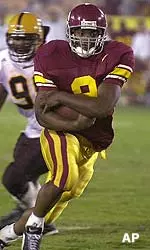
USC Football Team On 2-Game Win Streak
November 04, 2001 | Football
Nov. 4, 2001
Complete Weekly Release in PDF Format
 Download Free Acrobat Reader
THE FACTS
USC (4-5 overall, 3-3 in Pac-10 for sixth place) vs. California (0-8, 0-6 for 10th place), Saturday, Nov. 10, 12:30 p.m. PST, Memorial Stadium, Berkeley, Calif.
THEMES
USC, coming off an overtime victory over Oregon State, is inching closer to bowl eligibility as it has put together a modest 2-game winning streak while capturing 3 of its last 4 overall and 3 consecutive Pac-10 games. A win would put the Trojans at .500 for the year. California, on an 11-game losing streak, is trying to avoid its first winless season since 1897. Cal, the team Troy has played more than any opponent, posted its last win late last season (over USC). The Trojans are looking to snap a 3-game losing streak to the Golden Bears (in fact, Cal has won 4 of the last 5 meetings). The game will not be televised, snapping a streak of 48 consecutive USC games on live TV (it's only the second non-televised Trojan game since 1988). Three other USC teams-women's volleyball, women's soccer and men's water polo-have key contests in the Bay Area (including against Cal) over the weekend.
RANKINGS
USC and California are not ranked.
SERIES
This will be USC's 89th meeting with California, the team Troy has faced more than any other. USC leads the series, which dates back to 1915 (and is uninterrupted since 1926), 54-29-5. Cal has won the past 3 games and 4 of the last 5, the Trojans have won 16 of the last 23 meetings, 31 of the last 42 and 37 of the past 50. In games in Berkeley, USC is 28-12-1 and has won 5 of the past 7 there.
Last season in the Coliseum-despite a significant advantage in offensive statistics-USC dropped its fifth consecutive game of the season, this one to California, 28-16. It was Cal's third win in a row over USC (for the first time since 1948-50). Troy, off to its worst-ever conference start (0-5), had more total yards (320-213), plays (78-51), first downs (22-11) and possession time (33:14-26:46) than Cal, but couldn't capitalize. Cal's 51 plays were the fewest by a Trojan opponent since 1990 (when Washington had 50). The Bears scored just 4 plays into the game on a 44-yard pass from QB Kyle Boller to WR Phillip Pipersburg. But the Trojans scored on their first possession by driving 82 yards on 9 plays, as QB Carson Palmer threw a 19-yard TD pass to FB Chad Pierson. After Palmer fumbled away the ball on the USC 7-yard line while being sacked early in the second quarter, Cal TB Joseph Echema went 1 yard for a TD. But the Trojans took a 16-14 lead into halftime on a 32-yard scoring run by TB Sultan McCullough with just over 2 minutes to go and then, after recovering a Cal fumble on the ensuing kickoff, PK John Wall nailed a 25-yard field goal.
However, USC couldn't generate much offense in the second half (only 55 total yards and 6 first downs) and only crossed midfield on 1 series in the half (just to the Cal 45). The Bears went ahead for good late in the third quarter on a 12-yard Boller pass to WR Derek Swafford. Then, after USC had to punt early in the final quarter on its following possession, CB Jemeel Powell returned it 83 yards for a TD (he also intercepted a Palmer pass later in the quarter). Troy was also hampered by penalties (a season-high 11 for 101 yards), turnovers (2 interceptions, 1 fumble), sacks (7) and blocked kicks (a PAT and a field goal). McCullough had his third 100-yard rushing game in a row (a game-high 122 yards on 15 carries), Palmer was 19-of-32 for 202 yards and WR Kareem Kelly caught a game-best 5 passes for 42 yards. Boller hit 7-of-12 passes for 131 yards and TB Joe Igber rushed for 80 yards on 28 tries. LB Zeke Moreno led USC with 8 tackles and LB Markus Steele added 7 (2 for losses, with a sack).
In 1999 in USC's last visit to Berkeley, the Trojans-bothered by turnovers, sacks, untimely penalties and a stingy California defense-lost their fourth game in a row, this time 17-7 in frustrating fashion. It was USC's fewest points since being shut out by Washington in 1997 and its least against Cal since getting 6 in 1985. It also gave USC its longest losing streak since the 1991 team dropped a school-record 6 in a row. Against a Bear defense that topped the Pac-10 in total defense (353.7), rushing defense (115.0), scoring defense (25.0) and sacks (45), the Trojans turned the ball over 4 times (3 fumbles), were sacked 9 times, got inside the Cal 35-yard line on only 2 drives and had to punt 11 times. However, USC did manage 452 total yards (5.5 per play) and 23 first downs, but had only a touchdown to show for it. The Bears led 7-0 at halftime (USC had minus 15 rushing yards at that point while being sacked 7 times) after CB Deltha O'Neal intercepted a pass by QB Mike Van Raaphorst late in the second quarter and returned it 67 yards for a score (it was O'Neal's third scoring pickoff runback of 1999, a Cal record).
Cal extended its lead to 10-0 early in the third quarter on a 37-yard field goal by PK Mark-Christian Jensen that was set up by O'Neal's 60-yard punt return (O'Neal also had a game-high 9 tackles). On the next series, QB John Fox replaced Van Raaphorst and seemed to spark the Trojans, marching the team to the Cal 17 before Troy fumbled the ball away. But Fox-seeing his first significant playing time at quarterback since 1997-struck on USC's next series, hitting WR Kareem Kelly on a 72-yard TD pass, USC's longest pass play of 1999. Cal finished the scoring on the first play of the fourth quarter as QB Kyle Boller hit WR Ronnie Davenport for a 33-yard TD toss. USC's defense limited the Bears to just 232 total yards (only 82 rushing) and 9 first downs while forcing 10 punts. Although USC ran off 19 more plays (82-63), Cal held the ball for 32:59. Fox was 12-of-25 for 226 yards and Van Raaphorst was 14-of-24 for 156 yards, while Kelly had 9 catches for 170 yards, both then-career bests and game highs. TB Chad Morton ran for a game-best 84 yards on 12 carries (7.0 per try), while WR Windrell Hayes had 8 grabs for 88 yards and WR Marcell Allmond added a career-high 5 catches for 55 yards (Troy was without WR R. Jay Soward, who was sidelined by a hamstring pull). It was only the third time in USC history that a pair of receivers had at least 8 catches in a game. For Cal, Boller hit just 10-of-26 passes for 150 yards and had 2 intercepted (by CB Antuan Simmons in the end zone and S Ifeanyi Ohalete), while TB Marcus Fields had 66 yards on 24 rushes. LBs Zeke Moreno and Markus Steele and S David Gibson led USC with 7 tackles each.
CONNECTIONS
USC has 4 players who previously attended a Bay Area school: WR Grant Mattos (St. Francis HS in Mountain View and Foothill JC in Los Altos Hills), DE Omar Nazel (Skyline HS in Oakland), CB Matt Lemos (St. Francis HS in Mountain View) and WR Forrest Mozart (St. Francis HS in Mountain View)...USC head coach Pete Carroll has Bay Area roots: he was born in San Francisco, played football at Redwood High in Larkspur, Marin Junior College and Pacific, then was an assistant coach at Pacific (1974-76, 1983) and with the San Francisco 49ers (1995-96)...In fact, Carroll was the 49ers defensive coordinator when California head coach Tom Holmoe was the secondary coach there in 1995...Three other Trojan assistants have connections with Holmoe: USC secondary coach DeWayne Walker was Cal's secondary coach in 1996 when Holmoe was the defensive coordinator and in 1997 in Holmoe's first year as the Bears' head coach, USC running backs coach Wayne Moses did the same job on Cal's staff in 1996 when Holmoe was the defensive coordinator, USC offensive coordinator/quarterbacks coach Norm Chow was an assistant at BYU when Holmoe played there from 1980 to 1982 and was a graduate assistant coach there in 1990 and 1991...Two Trojan assistant coaches played pro football in the Bay Area: offensive line coach Keith Uperesa was with the Oakland Raiders in 1979 and secondary coach DeWayne Walker was with the USFL's Oakland Invaders in 1984...USC linebackers coach Nick Holt played football at Bellarmine Prep in San Jose...USC TB-FB David Kirtman's father, Louis, ran track at Cal...USC WR Grant Mattos' sister, Adrienne, is a senior All-American freestyler on California's swim team and set several school records, that Golden Bear women's swim team is coached by Teri McKeever, who was an All-American swimmer at USC in 1980-81 and later an of Troy (her late father, Mike, was an All-American guard for the 1959 USC football team assistant coach with the Women, while her uncle, Marlin, was a Trojan All-American end in 1959 and 1960)...USC pitching coach Dave Lawn was an assistant with Cal's baseball team from 1991 to 2000...Mark Long, an assistant athletic director at USC, lettered as an offensive lineman at Cal in 1983 and 1984...Dino Dennis, USC's equipment manager, was an assistant at California from 1975 to 1978...Law professor Noel Ragsdale, USC's faculty athletic representative, received her law degree from California in 1976.
TROJAN SPORTS WEEKEND IN BAY AREA
It's a big weekend for USC teams in the Bay Area, as 3 other Trojan teams besides football have contests up north...and all those games potentially could be league deciders. The highly-ranked women's volleyball team plays at California on Friday (Nov. 9) and at Stanford (Nov. 10), with both matches at 7 p.m. The Top 25-ranked women's soccer squad plays at Stanford on Friday (Nov. 9) at 7:30 p.m. and at California on Sunday (Nov. 11) at 11:30 a.m. And the Top 5-ranked men's water polo team is at California on Saturday (Nov. 10) at 10:30 a.m.
LAST GAME
QB Carson Palmer ran 4 yards on a naked bootleg for the game-winning touchdown in the first overtime period to give USC a 16-13 victory over Oregon State before a Homecoming crowd of 44,880 in the Coliseum and a regional ABC-TV audience, the second week in a row that the Trojans won a nail-biter. The Beavers had driven to first-and-goal at the USC 5-yard line on their overtime possession, but USC's defense stiffened, forcing a 29-yard field goal by PK Ryan Cesca. Then, after 4 runs by TB Sunny Byrd on Troy's ensuing overtime possession, Palmer threaded a 9-yard pass to TE Alex Holmes on third-and-eight from the OSU 12 to set up Palmer's winning run in which he broke one tackle and dove to the flag while getting slammed by another Beaver. The Trojans dodged defeat twice late in regulation when Cesca, the 2000 All-Pac-10 first team placekicker, missed field goals of 35 yards with 6:14 to play and 29 yards with 33 seconds to go. USC won despite generating just 204 total yards of offense, its fewest since getting 189 at Florida State in 1998 (and its fewest in a win since getting 197 at Baylor in 1986).
The Trojans ran for just 33 yards, saw Palmer sacked 6 times, averaged just 3.2 yards on their 64 offensive plays, had only 11 first downs (their fewest since getting 8 at Florida State in 1998), converted just 6-of-17 third downs and held the ball only 26:49. With Oregon State was backed up deep in its own territory on its first possession, USC got on the board first when S Troy Polamalu blocked P Carl Tobey's punt and WR Steve Stevenson recovered it in the end zone (it was Polamalu's second blocked punt of 2000 and third of his career, as well as Stevenson's second career TD on a blocked punt). Cesca hit a 24-yard field goal midway through the second quarter, but USC PK David Davis answered with a 30-yarder early in the third quarter. OSU then drove 96 yards to tie the game at 10-10 late in the third quarter, culminating on a 4-yard pass from QB Jonathan Smith to TB Steven Jackson. Palmer was 21-of-28 for 171 yards and an interception (including 13-of-15 for 80 yards in the first half while connecting on his first 9 aerials), Byrd had a team-best 54 yards on 20 carries and WR Kareem Kelly caught a team-best 5 passes for 73 yards. For OSU, Jackson came off the bench to run for a game-high 119 yards on 16 tries, TB Ken Simonton added 85 yards on 19 carries, Smith hit 20-of-33 passes for 203 yards with 1 pick and the TD, and WR James Newson had 6 catches for 94 yards (both game highs).
The Beavers had 384 total yards (181 rushing) and averaged 5.1 yards on their 75 plays. Polamalu and LB Mike Pollard each had a game-best 11 tackles (3 of Pollard's were for losses), while LB Frank Strong added 8 stops. USC sacked Smith 5 times. P Mike MacGillivray averaged 41.2 yards on his 10 punts. The win was USC's 18th in a row over Oregon State in the Coliseum and gave Troy its first 2-game winning streak since early in the 2000 season.
CLOSE LOSSES
USC might be the unluckiest team in America, as its 5 losses have been by a combined 25 points (5.0 average). Four of the defeats were by 5 points or less (2, 3, 4 and 5 points) and the fifth was by 11 points. Troy has never had a season in which it lost 4 games by 5 points or less. Two of the losses have come when foes have kicked field goals in the final 12 seconds, including once at the gun, the first time the Trojans have lost twice in a season in the final 12 seconds. Three of the losses were to teams ranked in the Top 12 at the time of the game and the 5 teams that beat USC have been ranked in the AP Top 25 at some point this season. Here's how close those losses have been:
CLOSE WINS
After suffering the 5 close losses mentioned above, perhaps the tide has turned for USC. Its past 2 wins were nailbiters, as Troy beat Arizona, 41-34, when CB Kris Richard returned an interception 58-yard for a TD with 1:50 to play and then defeated Oregon State in overtime, 16-13, on QB Carson Palmer's 4-yard run.
SCHEDULE
USC's 11-game schedule is challenging, featuring 7 teams that played in bowls last season and 5 that were ranked in AP's final Top 15. Four opponents are ranked in this week's AP Top 17. The current USA Today/Sagarin rankings say USC is playing the nation's 14th toughest schedule. Three of USC's opponents were ranked in the AP Top 12 at the time of the game and the first 5 foes were undefeated at game time (the sixth had just 1 loss). At the start of the season, Sports Illustrated said USC has the nation's toughest schedule, Phil Steele's magazine ranked it sixth toughest nationally and The Sporting News said USC plays the toughest schedule among TSN's pre-season Top 25 teams.
FUN FACT
This week's game at California will not be shown on live television, snapping a streak of 48 consecutive Trojan games on some form of live TV (Troy's last non-televised game was at Oregon State late in 1997). Incidentally, from 1988 through that 1997 OSU game, 111 USC games in a row were televised live.
CARROLL
Pete Carroll, who led the New England Patriots to the NFL playoffs twice in 3 years, brings big doses of experience, enthusiasm and leadership in his quest to revive the USC football program. He was named the Trojans' head football coach on Dec. 15, 2000 (he signed a 5-year contract). The 50-year-old Carroll, who also has coached on the college level for 10 years, has 26 years of NFL and college experience. He is 4-5 as a college head coach. He was the head coach of the NFL's New England Patriots for 3 seasons (1997-99) and New York Jets for 1 year (1994). He guided the Patriots into the playoffs in his first 2 seasons, winning the AFC Eastern Division title at 10-6 in 1997 and advancing to the second round of the playoffs, then posting a 9-7 regular season mark in 1998. His overall record in New England was 27-21 in the regular season (including 8-8 in 1999) and 1-2 in the playoffs. He owns the franchise's second-best winning percentage (54.9%).
After serving as the Jets' defensive coordinator for 4 seasons (1990-93), he became the team's head coach the following season. His 1994 Jets went 6-10. Only 3 other Jets head coaches won more games in their rookie campaign. He spent the next 2 years (1995-96) as the defensive coordinator with the San Francisco 49ers, who won the NFC Western Division title both seasons. The 49ers were 11-5 in the 1995 regular season when they had the NFL's top-ranked defense and then went 12-4 in 1996. Carroll began his coaching career at the college level, serving as a graduate assistant at his alma mater, Pacific, for 3 years (1974-76), working with the wide receivers and secondary. He then spent a season each as an assistant in charge of the secondary at Arkansas (1977) under Lou Holtz as the Razorbacks won the 1978 Orange Bowl, at Iowa State (1978) under Earle Bruce (the Cyclones played in the 1978 Hall of Fame Bowl) and at Ohio State (1979) under Bruce. That Buckeye squad lost to USC in the 1980 Rose Bowl. He next spent 3 seasons (1980-82) as the defensive coordinator and secondary coach at North Carolina State, then returned to Pacific in 1983 as the assistant head coach and offensive coordinator. He entered the NFL in 1984 as the defensive backs coach of the Buffalo Bills, then held a similar position with the Minnesota Vikings for 5 seasons (1985-89). The Vikings advanced to the playoffs his last 3 years there, getting to the NFC Championship game in 1987.
The 1988 team was 11-5 in the regular season and the 1989 squad won the NFC Central Division crown with a 10-6 mark. His secondary averaged 25 interceptions a season and led the NFL in passing defense in 1989. Carroll spent the 2000 season as a consultant for pro and college teams, doing charitable work for the NFL and writing a column about pro football for CNNSI.com. Carroll was a 2-time (1971-72) All-Pacific Coast Conference free safety at Pacific and earned his bachelor's degree in 1973 in business administration. He received his secondary teaching credential and a master's degree in physical education from Pacific in 1976. He was a 3-sport (football, basketball and baseball) standout at Redwood High in Larkspur, Calif., earning the school's Athlete of the Year award as a senior. He played quarterback, wide receiver and defensive back. He then played football at Marin Junior College in Kentfield, Calif., in 1970. He was born on Sept. 15, 1951 in San Francisco. He and his wife, Glena, who played volleyball at Pacific, have 3 children: sons Brennan, 22, a senior tight end at Pittsburgh (he previously played at Delaware), and Nathan, 14, and daughter Jaime, 19, a sophomore on the USC women's highly-ranked volleyball team which competed in the 2000 NCAA Final Four. His late father-in-law, Dean Goranson, received his master's degree from USC.
PALMER
USC has one of the nation's better signalcallers in 2001 in junior Carson Palmer (174-of-293, 59.4%, 2,157 yds, 11 TD, 11 int in 2001, plus 68 tcb, 44 yds, 0.6 avg, 1 TD). He is on the "Watch List" for the 2001 Davey O'Brien Award. His 59.4% completion rate in 2001 is tops among Pac-10 starting quarterbacks. His 174 completions in 2001 is ninth on the USC season chart and his 2,201 yards of total offense in 2001 is 11th on Troy's season list. He already ranks third on Troy's career passing list (571 completions). He is also third on USC's all-time total offense chart (7,251 yards), 15th on the Pac-10 career list. His 7,316 career passing yards are third-most in USC history and 16th in Pac-10 annals. His 37 career TD tosses is tied for fourth most at USC and 37th on the Pac-10 ladder. He owns the USC single game total offense record (419 yards at Oregon in 2001) and his 411 passing yards in that game were 4 shy of tying another school mark.
He is on pace to break Rob Johnson's school career records for completions (676) and passing yardage (8,472), plus Rodney Peete's USC career total offense yardage mark (8,640). He had a span this season where he threw 87 consecutive passes without an interception before getting picked off at Notre Dame. With 29 career starts under his belt, he has completed at least 60.0% of his passes 14 times (including 6 contests at 70.0%-plus) and thrown for at least 200 yards 18 times. After missing the last 9 games of 1999 with an injury, in 2000 he showed signs of brilliance (his 228 completions and 2,914 passing yards were the second most in USC history) and rustiness (he tied the school interception mark with 18). His 5,159 career passing yards through the 2000 season were the most by a Trojan at the end of his sophomore year.
OTHER QUARTERBACKS
Besides Carson Palmer, no other quarterback on the Trojan roster has ever thrown a pass in college. Redshirt freshman Matt Cassel (2 tcb, 2 yds, 1.0 avg in 2001) and 2000 prep All-American freshman Matt Leinart are competing to be Palmer's backup in 2001. Cassel has appeared in 4 games in 2001 (Washington, Notre Dame, Arizona and Oregon State) as a wide receiver (he gained 4 yards on a reverse at Notre Dame).
McCULLOUGH
Troy returned a 1,000-yard runner in 2001 and he's a good one: speedy junior tailback Sultan McCullough (115 tcb, 410 yds, 3.6 avg, 5 TD in 2001, plus 6 rec, 16.7 avg, 1 TD). He is listed as a candidate for the 2001 Doak Walker Award. He is 14th on USC's prestigious career rushing chart with 1,986 yards and has run for at least 100 yards in 9 games at Troy (twice in 2001). But he sat out most of the Arizona State contest and all of the Notre Dame, Arizona and Oregon State games with a strained abdominal muscle. His rushing total of 1,163 yards last fall was the most at USC since 1990. He hit the 100-yard rushing barrier 7 times in 2000 (the most by a Trojan since 1989), including 4 games in a row. That was good enough to earn him All-Pac-10 second team acclaim in 2000. The 1999 Pac-10 champion in the 100-meter dash, he is the fastest player ever to wear a Trojan football uniform (10.17 in the 100 meters).
OTHER RUNNING BACKS
Coming into 2001, it looked like the Trojans would have a 1-2 punch at tailback with Sultan McCullough joined by powerful and experienced senior Malaefou MacKenzie (41 tcb, 284 yds, 6.9 avg in 2000, plus 27 rec, 9.2 avg), a threat running and receiving. But MacKenzie left the team this midseason without seeing action in 2001: he missed USC's first 2 games with a knee sprain, the third while attending his father's funeral in Western Samoa and the next 2 after re-spraining his knee. He then decided to go back to Western Samoa for the rest of the season. He was second on the Trojans in rushing last season (284 yards) and his 27 receptions were the most by a USC running back since 1996. In his career (which includes 4 starts), he has 765 rushing yards and 37 receptions. Besides McCullough and MacKenzie, Troy's other true tailbacks have carried the ball only 16 times in their careers. Redshirt freshman Chris Howard (11 tcb, 12 yds, 1.1 avg in 2001, plus 2 rec, 6.5 avg), who is coming off 2000 knee surgery, and freshmen Darryl Poston (5 tcb, 4 yds, 0.8 avg, 1 TD in 2001), a 2000 prep All-American, are angling for backup tailback duty.
However, Poston sprained his knee at Notre Dame and missed the Arizona and Oregon State games. At fullback, senior Charlie Landrigan (8 tcb, 12 yds, 1.5 avg in 2001, plus 27 rec, 12.6 avg, 2 TD and 3 tac), an outstanding blocker and receiver, returned as the starter. Behind him are juniors Sunny Byrd (84 tcb, 246 yds, 2.9 avg, 3 TD in 2001, plus 8 rec, 6.8 avg and 5 tac), who redshirted last fall after transferring from a junior college, Chad Pierson (3 rec, 20.3 avg, 1 TD in 2001), who missed the first 6 games of 2001 after having surgery for a herniated disk in his back, and Scott Huber, a converted tight end who had 1 start last fall but no receptions. Byrd has all of his 2001 carries while running out of the tailback spot for an injured McCullough (against Arizona State, Notre Dame, Arizona and Oregon State), he even started versus Notre Dame, Arizona and Oregon State. He has had at least 20 carries in his last 4 games, leading Troy in rushing each outing.
KELLY
Kareem Kelly (team-best 40 rec, 16.9 avg, 2 TD in 2001, plus 2 tcb, 9 yds, 4.5 avg and 8 PR, 6.4 avg), an acrobatic, fleet junior, headlines USC's receiving corps. He was on the "Watch List" for the 2001 Biletnikoff Award, given to the nation's top receiver. He already is fifth on Troy's all-time pass catching chart with 149 grabs, tied for 24th on the Pac-10 career list. His 2,302 career yards is 22nd on the Pac-10 career ladder. He is within sight of Johnnie Morton's school record for receptions (201) and receiving yardage (3,201). He has a reception in all 32 games he has played as a Trojan, within range of John Jackson's USC record of 37. He has had 100-yard receiving games 9 times in his career (twice in 2001). Last fall, he topped the Trojans in receptions (55) and receiving yardage (796), in 1999, he set Pac-10 freshman records for most catches (54) and receiving yards (902). He also sprints for USC's track squad (his 5.67 clocking in the 50-meter dash is an American collegiate and world junior record).
OTHER WIDE RECEIVERS
In addition to Kareem Kelly, USC's wide receiver corps in 2001 has a nice blend of experienced, speedy veterans and talented newcomers. Last year's co-starters at the other wideout spot also returned in sophomore Keary Colbert (28 rec, 13.1 avg in 2001, plus 1 tcb, 9 yds, 9.0 avg and 2 tac) and junior Marcell Allmond (16 rec, 15.2 avg in 2000). However, Allmond-who doubles as a hurdler and decathlete on the Trojan track team-will miss USC's 2001 games while suspended for a student conduct violation. He was off to a good start in 2000 before breaking his leg in the fifth game and sitting out the rest of the way. Colbert took over for him then and ended up second on the team in receptions with 33 (the second most ever by a USC freshman). Also in the mix is a pair of junior college transfers-2000 J.C. All-American Grant Mattos (10 rec, 10.4 avg in 2001, plus 2 tac), a junior, and sophomore Devin Pitts (10 rec, 6.1 avg in 2001)-plus junior Steve Stevenson (1 rec, 0.0 avg in 2001, plus 1 TD on blk P), who has 22 catches, 3 starts and 2 TDs on recoveries of blocked punts in his career, and sophs Sandy Fletcher (1 rec, 6.0 avg in 2001, plus 2 tac) and D. Hale (3 rec, 10.7 avg in 2001), a walk-on who even started at Arizona. Mattos missed the Notre Dame, Arizona and Oregon State contests with a knee sprain.
TIGHT ENDS
USC had quite a challenge in finding a replacement in 2001 for dependable 4-year starting tight end Antoine Harris, who had 61 catches and 7 scores in his career. Going into the 2001 season, the tight ends had just 11 catches and limited offensive playing time to their names. The starter came from an unlikely spot: defense. Rangy senior Kori Dickerson (18 rec, 12.5 avg, 2 TD in 2001) was last season's starting strongside linebacker, where he notched 32 tackles. He was moved to tight end this past spring and was impressive. He doubles as a 6-8 high jumper for the USC track team. Behind him are sophomore Alex Holmes (16 rec, 6.6 avg, 2 TD in 2001), a Freshman All-American second teamer last year, and junior Doyal Butler (4 rec, 13.0 avg in 2000).
OFFENSIVE LINEMEN
Three-fifths of USC's starters on the offensive line are back in 2001 and each is a solid player. But the rest of the unit is relatively inexperienced, which is a concern since Troy starts new tackles and must develop some reliable depth along the line. Usually manning the guard spots are senior Faaesea Mailo, who started at tackle last season but had 6 starts earlier in his career at left guard, and junior Zach Wilson, a 3-year starter on the right side. Both tip the scales at more than 300 pounds. Mailo, the only senior lineman, fills the left guard spot held by Trevor Roberts last fall. A twisted knee slowed him in fall camp, so sophomore Norm Katnik started there in the San Jose State opener and then again (because of better showings in practice) versus Stanford and Oregon State (Mailo came in off the bench in all those games). Katnik can play any line position: he worked mainly at center in 2000, was moved to tackle last spring, went back to center this fall and now is also working at guard. So far in 2001, he has appeared at all 3 line spots, even starting at center versus Oregon, Washington, Arizona State and Notre Dame and at guard against Stanford (left), Arizona (right) and Oregon State (left). Sophomore Lenny Vandermade returned as the center after earning Freshman All-American first team honors last year (he also started some at guard in 2000). He is on the "Watch List" for the 2001 Dave Rimington Trophy, given to the nation's top center. He didn't start (but played off the bench) versus Oregon, Arizona State and Notre Dame and he did not see action at Washington this season Vandermade also has played some at guard in 2001. Sophomores Jacob Rogers (he missed last spring's practice while recovering from shoulder surgery) and Eric Torres (he saw limited time in 2000) won the starting tackle jobs vacated by 3-year starter Brent McCaffrey on the left and Mailo on the right.
DEFENSIVE LINEMEN
The situation on the USC defensive line coming into 2001 was not as dire as it might have appeared. Although starters were gone at 3 positions-tackle Ennis Davis (who had 146 tackles, including 36 for losses with 15 sacks, as a 3-year starter) and ends Sultan Abdul-Malik (a 3-year starter who had 22.5 career sacks) and Matt Childers (a 2-year starter)-USC had plenty of quality bodies to fill in. Last year, senior Ryan Nielsen (23 tac, 2 for loss, 2 sack, 1 dfl, 1 FR in 2001) and junior Bernard Riley (26 tac, 5 for loss, 1 sack, 1 FR, 1 dfl, 1 int in 2001) shared a tackle spot. This season, Nielsen-a 3-year starter-and Riley started off side by side at tackle. However, Nielsen sprained his shoulder against Stanford and missed the Washington game, so 2000 prep All-American freshman Shaun Cody (22 tac, 4 for loss, 3 sack in 2001, plus 1 KOR, 22.0 avg), who was USA Today's national Defensive Player of the Year last season, has started there since the Washington contest (Cody began the year as a backup end, but moved to tackle after the second contest). And then when Riley tore ligaments in his knee at Washington and was lost for the season, Nielsen returned for the Arizona State contest and has started since at Riley's nose tackle spot. Another first-year freshman, Mike Patterson (4 tac, 2 for loss, 1 sack, 1 FF, 2 FR in 2001), also has been pressed into action at nose tackle. One end spot is a pseudo-linebacker, giving USC's 4-3 look a 3-4 feel. Senior Lonnie Ford (31 tac, team-high 12 for loss, team-best 5 sack, 2 dfl, team-high 4 FF in 2001), who has 25 tackles for losses and 21 starts in his career, is the ideal man for that job, with soph Omar Nazel (9 tac, 2 for loss, 2 sack, 1 int, 1 dfl in 2001), who saw brief action in 5 games last season without making a stop, backing him up. Ford currently is tied for the Pac-10 lead in forced fumbles (4), tied for fourth in tackles for a loss (12) and tied for fifth in sacks (5). The other end has been shared by redshirt freshman Kenechi Udeze (25 tac, 6 for loss, 2 sack, 1 FR, 1 FF, 1 dfl in 2001) and senior Bobby DeMars (3 tac, 2 dfl, 1 int, 1 blk FG in 2001), who had seen limited action entering the 2001 season. Udeze-who has seen action in every games in 2001-started every game except Oregon and Stanford, which DeMars started (but DeMars suffered a neck sprain versus Stanford and missed the Washington and Arizona State contests). True freshman Jason Wardlow (3 tac in 2001) also has seen some action at end.
LINEBACKERS
Of any area on the USC team, the linebacking corps faced the biggest challenge in 2001. After all, Troy had to replace all 3 starters, including a pair of elite linebackers: 3-year starter Zeke Moreno, who posted 285 tackles (33 for loss), 5 picks and 4 touchdowns in his career while topping the Trojans in stops the past 2 seasons, and 2-year starter Markus Steele, who made 152 tackles (29 for loss) in his career. Last year's starter on the strong side (Kori Dickerson) moved to tight end. Filling in at middle linebacker for Moreno are juniors Mike Pollard (72 tac, 8 for loss, team-best 6 dfl, 1 FR, 2 FF in 2001) as the starter and backup Aaron Graham (4 tac, 1 for loss, 1 sack in 2001), who started there for USC's final 4 games last fall when Moreno moved to the weakside for an injured Steele, and redshirt freshman backup Lee Webb (6 tac in 2001), a converted fullback who broke his foot against Stanford and has been sidelined since. The outside spots manned last season by Steele on the weak side and Dickerson on the strong side are being handled by a pair of converted safeties: senior Frank Strong (44 tac, 2 for loss, 5 dfl, 1 int, 1 FR, 2 FF in 2001, plus 1 KOR, 23.0 avg), who was a free safety the previous year-and-a-half and also was USC's top kickoff returner last year (21.6 avg on 25 runbacks), on the weak side and redshirt freshman Matt Grootegoed (32 tac, 8 for loss, 1 sack, 1 FR, 2 dfl in 2001), who sat out last year with mononucleosis, on the strong side. Strong has even been forced back into kickoff return dury in 2001 because of injuries, an unusual role for a linebacker. When Strong missed the Kansas State game with a knee sprain and Grootegoed missed the Oregon and Stanford games with a shoulder sprain (he didn't start at Washington, but saw brief duty on special teams), senior John Cousins (24 tac, 1 for loss in 2001)-who is deaf in one ear and hearing impaired in the other-got the starts versus Kansas State and Oregon and sophomore Chris Prosser (12 tac, 3 for loss, 1 sack, 1 dfl in 2001), who missed USC's first 2 games of 2001 while ineligible, got the starts versus Stanford and Washington (he missed the Arizona State, Notre Dame, Arizona and Oregon State games with a concussion). Also seeing backup duty on the outside is true freshman Bobby Otani (1 tac in 2001), but he has been sidelined with torn knee ligaments prior to the Arizona contest.
DEFENSIVE BACKS
There is an embarrassment of riches in the USC secondary in 2001 in terms of experience and depth. Seven players have started there in their careers. Junior Troy Polamalu (team-high 92 tac, 10 for loss, 1 sack, 4 dfl, 1 int which was returned for a TD, 2 FF, 1 FR, 2 blk P in 2001, plus 2 PR, 10.0 avg) was the team's No. 2 tackler last fall (83) while starting all season at strong safety. He currently is second in the Pac-10 in tackles (10.2). He has blocked 3 punts in his career. Senior Antuan Simmons (25 tac, 1 for loss, 1 sack, 1 int, 2 dfl, 1 FF in 2001), a 3-year starter at cornerback (he was moved to safety this fall) who sat out the 2000 campaign while battling a life-threatening illness (a benign abdominal tumor that left him hospitalized for 6 weeks), emerged as the starter at free safety. He slowly worked his way back into shape, was impressive in last spring's practice and won the free safety job this fall. He is an impact player, with 200 tackles, 8 interceptions and 6 blocked kicks in his career. Behind Simmons is junior DeShaun Hill (21 tac, 1 for loss, 1 dfl, 1 int, 1 FR in 2001), who shared the starting free safety duty last season with Frank Strong, while redshirt freshman Jason Leach (3 tac in 2001) backs up Polamalu. The corners are equally stacked. Senior Chris Cash (47 tac, 3 for loss, 2 int, 1 dfl, 1 blk FG in 2001) starts on one side and is backed by the player he shared the spot with in 2000, junior Darrell Rideaux (7 tac in 2001, plus 17 KOR, 19.4 avg), who also is a sprinter for USC's track team with a best of 10.27 in the 100 meters. Rideaux sprained an ankle at Arizona and missed the Oregon State game. On the other side, there's senior 3-year starter Kris Richard (40 tac, 4 for loss, 2 sack, 1 FF, 5 dfl, 2 int with a 58-yard TD return, 1 TD on a blk FG in 2001), who also was Troy's top punt returner last season (7.5 avg on 13 runbacks). He has 8 career picks. Backing him up and serving as the nickel back is junior Kevin Arbet (18 tac, 2 for loss, 1 sack, 5 dfl, 2 int with a 70-yard TD return, 1 FR in 2001, plus 17 PR, 9.6 avg and 3 KOR, 17.7 avg), a 4-game starter last year and the stepson of ex-USC receiver Jeff Simmons. Arbet sprained an ankle at Arizona and missed the Oregon State game.
SPECIALISTS
Senior Mike MacGillivray (39.6 avg in 2001), who owns a 39.4 career punting average while punting for the fourth year, is a battle-tested veteran but has struggled with his consistency. An effective placement punter, more than a third (98) of his career punts have pinned opponents within the 20-yard line (including 24 of his 62 boots in 2001) and 29 have traveled 50-plus yards. He owns the USC career record for punts (281) and punt yardage (11,073). USC's placekicking was an adventure in 2000 and 2 of the 3 kickers are back, but a newcomer has won the job: junior David Davis (21-of-23 PAT, 11-of-13 FG in 2001), a junior college transfer who had an impressive fall camp and has continued that way this season. Davis, who has hit his last 8 field goal attempts and 11 of his last 12, is the Pac-10's most accurate field goal kicker (84.6%). Senior David Newbury (4-of-9 FG, 9-of-12 PAT in 2000) began 2000 as the kicker, but he was inconsistent (he is handling the kickoffs this fall, with 8 of his 45 kickoffs pinning opponents within the 20, with 1 touchback and 1 on-side recovery). Because he doesn't have the leg to consistently knock his kickoffs into the end zone and because of USC's mediocre kickoff return coverage, in the Arizona and Oregon State Newbury resorted to pooch kicks at times (resulting in 7 fair catches). Newbury was replaced midway through last season's fifth game by sophomore John Wall (5-of-5 FG, 9-of-14 PAT in 2000), whose field goals were all within 27 yards and his 5 missed extra points were all blocked. When Wall was sidelined by a groin injury and then a knee injury in the final 3 contests of 2000 (he's still coming around from that knee injury), the now-graduated David Bell took over. Primarily USC's effective kickoff man the past 4 years (nearly 50% of his 243 career kickoffs were not returned past the 20-yard line, with 62 touchbacks), Bell long will be remembered for his game-winning field goal with 9 seconds to go at UCLA last fall (it was only the second three-pointer of his career and the first after 3 misses in 2000).
STAT NOTES
CAPTAINS
USC's 2001 captains, by vote of the players, are FB Charlie Landrigan, CB-S Antuan Simmons and S Troy Polamalu.
ASSISTANT COACHES
With the head coaching change this year, there are 7 new assistant coaches on the USC staff: offensive coordinator/quarterbacks coach Norm Chow (who worked wonders last year at North Carolina State and before that for 27 years at BYU, where he coached such star quarterbacks as Steve Young, Jim McMahon, Marc Wilson, Gifford Nielsen, Ty Detmer and Robbie Bosco), associate head coach/secondary coach DeWayne Walker (he spent the past 3 years with the New England Patriots after stops at Utah State, BYU, Oklahoma State and California), running backs coach Wayne Moses (who has coached Pac-10 runners the last 11 years at Washington, California and UCLA), wide receiver coach Kirby Wilson (he was with the Washington Redskins and New England Patriots following stints at Iowa State, Southern Illinois and Wyoming), offensive line coach Keith Uperesa (he came from Idaho State after a long and successful career at Snow J.C.), linebackers coach Nick Holt (previously at Louisville and Idaho) and tight ends coach Lane Kiffin (the son of longtime NFL and college coach Monte Kiffin). They join holdovers Ed Orgeron (defensive line coach/recruiting coordinator) and Kennedy Pola (special teams coordinator). Two young coaches-offensive assistant Steve Sarkisian (a record-setting quarterback under Chow at BYU) and defensive assistant Rocky Seto (a former USC linebacker)-joined the staff as graduate assistants.
RANDOM NOTES
USC IS THE PLACE TO BE
Based on several national accolades it has received recently, USC can stake its claim as one of the nation's premier schools. USC was named the "College of the Year" by the 2000 edition of the Time/Princeton Review College Guide because of the remarkable bonds it has forged with the local community. The editors said USC has one of the most ambitious social-outreach programs of any university in the nation and cited the school's model of service learning (applying academic theory to real-life situations through public service). They also pointed out that USC's undergraduate applications have nearly doubled over the last few years and it is enrolling the most academically accomplished freshman classes in its history. Troy also was selected as one of America's nine "hottest schools" by the 2001 edition of the Newsweek/Kaplan College Guide because it lives up to its reputation as a top-notch institution of higher education. Students quoted in the guide said that what attracted them to the university was Los Angeles' ethnic diversity, the offer of scholarships, the small classroom sizes and USC's standing in academe. Also in 2001, the Association of American Colleges and Universities picked USC as one of 16 "Leadership Institutions" for providing stimulating educational experiences both inside and outside of the classroom. USC was cited for emphasizing a campus culture featuring new learning techniques, curriculum and organizational structure and for demonstrating a strong commitment to liberal arts education relevant to the contemporary world. The organization said USC not only linked liberal arts and pre-professional study, but offered students the opportunity to learn by doing through off-campus work in community projects and internships. Also, USC was lauded for stressing critical thinking, effective communication and contributing to a diverse society.
ACADEMICS
USC's two most recent graduation rates for football are the highest in USC history. The 2001 official NCAA graduation rate for Trojan football players was 82%, an all-time high (topping the previous USC high of 80% in 2000). That rate compared to 73% for the general USC student body...and it was about 30 percentage points higher than the national football average for Division I schools. Among the top scholars on the 2001 Trojan squad are LB Aaron Orndorff (team-high 3.89 GPA in geology), TE Chad Cook (3.22, business), TB Mark Gomez (3.22, political science), QB Matt Cassel (3.14), OG Spencer Torgan (3.03, business), DE Bobby DeMars (2.96, business administration), P Mike MacGillivray (2.95, public policy and management), C-SNP Joe Boskovich (2.92, business), TE-FB Scott Huber (2.91, communication), TE Alex Holmes (2.87, business), P Tommy Huff (2.85, history), CB Matt Lemos (2.81), TE Gregg Guenther (2.76) and DE Jay Bottom (2.75). Huber was a 1999 and 2000 Pac-10 All-Academic honorable mention choice. In its history, USC football has produced 22 Academic All-American first teamers (tops in the Pac-10 and sixth in the nation), 20 NCAA Post-Graduate Scholarship winners, 12 National Football Foundation Scholar-Athletes, 4 NCAA Today's Top Six winners, 1 Rhodes Scholar and 1 Academic All-American Hall of Famer.
WEIGHTY MATTERS
The conditioning of USC's players has markedly improved under new strength and conditioning coach Chris Carlisle and his staff (Carlisle was hired in February of 2001). For instance, the team average in the bench press at the end of 2000 spring practice was 318 pounds (with only 4 players lifting 400-plus pounds), but it improved to 341 pounds at the end of 2001 spring drills (15 hoisted 400-plus) and entering the 2001 fall season the average was at 369 pounds (with 25 players at 400-plus). In the power clean, the spring 2000 team average was 270 pounds (with just 4 players lifting 300-plus pounds), then the spring 2001 mark improved to 283 pounds (with 18 hitting 300-plus) and going into this fall season the average was at 292 pounds (32 players are at 300-plus). Additionally, every Trojan currently has a body fat lower than 20%.
McKAY MEMORIAL RESCHEDULED
A memorial service for legendary football coach John McKay, which was postponed because of the tragic Sept. 11 events on the East Coast, has been rescheduled for Tuesday, Nov. 13, at 2:30 p.m. at USC's Bovard Auditorium, with a reception immediately following in Heritage Hall. Eulogies will be given by USC athletic director Mike Garrett, USC president Steven Sample, longtime Trojan broadcaster Tom Kelly, former USC assistant football coaches Dave Levy and Marv Goux, and ex-Trojan quarterback Pat Haden. McKay's son, J.K., and wife, Corky, will share remembrances. There will also be a video tribute to McKay. The memorial service, which was originally planned for Sept. 12, is open to the public on a first-come, first-seated basis. Campus parking is available through Gates 1 (Exposition and Watt) and 6 (Vermont and 36th). The reception is co-hosted by the Trojan Football Alumni Club. McKay, who won four national championships at USC before becoming the first head coach of the NFL's Tampa Bay Buccaneers, died of kidney failure due to complications from diabetes this past June 10 in Tampa, Fla.
IN THE NFL
USC is always well-represented in the NFL. At the start of training camp this summer, there were 38 ex-Trojans on NFL rosters. Last year, there were 31 Trojans on opening day NFL rosters, including players such as LBs Junior Seau and Chris Claiborne, OLs Tony Boselli and Bruce Matthews, DLs Willie McGinest and Darrell Russell, WRs Keyshawn Johnson and Johnnie Morton, QB Rob Johnson and DBs Jason Sehorn, Sammy Knight and Daylon McCutcheon. Six NFL head coaches have USC ties (either as former players or assistants): New York Giants' Jim Fassel, Tennessee's Jeff Fisher, Seattle's Mike Holmgren, San Francisco's Steve Mariucci, Miami's Dave Wannstedt and San Diego's Mike Riley. Eight current USC players have relatives with NFL playing backgrounds: WR William Buchanon (father, Willie Buchanon), LB Austin Jackson (father, Melvin Jackson), WR Kareem Kelly (cousin, Rashard Cook), LB-S Kyle Matthews (grandfather, Clay Sr., father, Clay Matthews, uncle, Bruce Matthews), TB Sultan McCullough (brother, Saladin McCullough), S Troy Polamalu (cousin, Nicky Sualua), WR Justin Tolliver (father, Kevin Williams) and OG Travis Watkins (uncle, Tom Watkins). Additionally, head coach Pete Carroll was an NFL head coach and assistant coach, and assistants DeWayne Walker, Kirby Wilson and Lane Kiffin were NFL assistants. Five assistant coaches played professionally: Keith Uperesa in the NFL, Walker, Wilson, Norm Chow and Steve Sarkisian in the CFL and Walker also played in the USFL.
ON TV
USC is one of America's most televised teams. The Trojans have appeared on live national, regional or local telecasts 293 times, including the past 48 games dating back to the 1997 season. In fact, USC had an amazing streak of 111 consecutive games on some form of live television from 1988 to 1997.
ROSTER UPDATES
There are a number of updates from the roster in the 2001 USC football media guide. There are 4 new scholarship players who have transferred this fall from junior colleges or colleges (their complete bios are below): #17 Devin Pitts (WR, 6-4, 190, So*./Jr., Carson, El Camino JC/North Torrance HS), #48 David Davis (PK, 5-11, 160, Jr./Jr., Hawthorne, El Camino JC/Bishop Montgomery HS), #51 Melvin Simmons (LB, 6-1, 210, Jr./Jr., Compton, Washington State/Dominguez HS) and #87 Grant Mattos (WR, 6-2, 220, Jr./Jr., Mountain View, Foothill JC/St. Francis HS, pronounced MAT-toaz). Five other players have joined the squad as freshmen walk-ons: #14 Greig Carlson (WR, 5-10, 190, Fr./Fr., Woodland Hills, Pacific Palisades HS), #15 Zach Sherwood (P, 6-3, 190, Fr./Fr., Irvine, University HS), #27 Andre Woodert (WR, 6-0, 195, Fr./Fr., Los Angeles, Agoura HS), #38 Justin Tolliver (CB, 5-8, 150, Fr./Fr., New Orleans, La., De La Salle HS) and #60 Collin Ashton (LB, 6-1, 205, Fr./Fr., Mission Viejo, Mission Viejo HS). Three returning walk-ons have changed jersey numbers: P Tommy Huff is now #16, TE-SNP Alex Bottom is now #46 and WR Forrest Mozart is now #47. Also, delete LB Henry Wallace and walk-ons PK Anthony Boscarini and CB Brien McMullen, who have quit, walk-on QB Matt Harris, who transferred to UNLV, and LB Marvin Simmons, DE Raymond Tago and DE Daniel Pryor, who each did not qualify for admission. Several players have switched positions: Frank Strong and Matt Grootegoed are now at LB, Antuan Simmons and Kevin Arbet are at CB-S, Eric Reese is a TB, Scott Huber is a TE-FB, Norm Katnik is an OT-C, Joe McGuire is an OT-OG, Kenechi Udeze is a DT-DE, John Walker is a S-CB, David Kirtman is a TB-FB and Kyle Matthews is a LB-S. Finally, Sunny Byrd's eligibility should be changed to Jr.*/Sr.
BIOS OF NEW SCHOLARSHIP TROJANS
DEVIN PITTS-
He was a 2000 J.C. Grid-Wire All-American honorable mention and Super Prep JUCO 100 pick as a redshirt freshman at El Camino Junior College in Torrance (Calif.)...He caught 68 passes for 1,156 yards (17.0 avg.) and 8 TDs in 2000, and was ranked 10th in the California juco ranks in receptions per game (6.3)...He attended El Camino in 1999, but did not play football because of an injury...Current Trojans Sunny Byrd and David Davis also attended El Camino...He won 1998 All-CIF Division X, South Bay Daily Breeze All-South Bay second team and All-Ocean League honors as a senior at North Torrance (Calif.) High...He had 48 receptions for 861 yards (17.9 avg.) and 9 TDs in 1998...He also ran track at North Torrance, with a best of 10.8 in the 100 meters...His mother, LaVerne, was on the basketball and track teams at Cal State Dominguez Hills, while his older brother, Chester, is a senior offensive lineman at San Diego State...His cousin is major league slugger Barry Bonds.
DAVID DAVIS-
He was a 2000 J.C. Grid-Wire All-American second team and J.C. Athletic Bureau All-State Region IV first team pick as a sophomore placekicker at El Camino Junior College in Torrance (Calif.)...He hit 11-of-15 field goals and 29-of-31 PATs for 62 points in 2000...As a 1999 redshirt freshman at El Camino, he made 6-of-11 field goals and all 47 of his PATs for 65 points...He also played soccer in 1998 as a freshman at El Camino...Current Trojans Sunny Byrd and Devin Pitts also attended El Camino...He prepped at Bishop Montgomery High in Torrance (Calif.), where he played football (placekicker and wide receiver as a 1997 senior), soccer and baseball...Current Trojan Eric Torres also prepped at Bishop Montgomery...He is a left-footed kicker.
MELVIN SIMMONS-
He must sit out the 2001 season after transferring from Washington State (a year was waived from the 2-year in-conference transfer rule, making him eligible in 2002 instead of 2003)...He started 10 games at both middle and weakside linebacker as a 2000 sophomore at Washington State, getting 59 tackles (fourth on WSU), including 7 for losses of 24 yards (with 4 sacks for minus 19 yards), plus a deflection...Posted 9 stops against Stanford, 7 versus Washington and Utah and 6 (with 2 sacks) against Arizona State in 2001...Missed the 2000 California game with a shoulder injury...Saw action in 12 games as a first-year freshman in 1999, as a reserve linebacker and on special teams...Had 6 tackles in 1999...Received Blue Chip All-American, Super Prep All-Far West, All-CIF and All-League MVP honors as a 1998 senior at Dominguez High in Compton (Calif.)...Made 142 tackles with 5 sacks in 1998...As a 1997 junior, he made All-League first team while notching 138 tackles (with 6 sacks)...Was on the All-State Sophomore and All-League second team as a 1996 sophomore as Dominguez won the CIF title...Also was on the track and baseball teams at Dominguez...Is nicknamed "Champ."
GRANT MATTOS-
He was a 2000 J.C. Athletic Bureau All-American first team, J.C. Grid-Wire All-American honorable mention, Super Prep JUCO 100, J.C. Athletic Bureau All-State Region II Offensive MVP and All-League MVP choice as a sophomore wide receiver at Foothill Junior College in Los Altos Hills (Calif.)...He had 76 receptions for 1,200 yards (15.8 avg.) and 14 TDs in 2000, plus returned 5 punts for 17 yards (3.4 avg.)...He was sixth in the California juco ranks in receptions per game (6.8) and 18th in scoring (7.8)...Foothill went 8-3 and won the Silicon Valley Bowl in 2000...As a 1999 freshman at Foothill, he had 46 catches for 509 yards (11.1 avg.) with 6 TDs...Foothill was 10-1 and won the Silicon Valley Bowl in 1999...He was named a Scholar-Athlete at Foothill...He was a 3-year (1996-98) starter at St. Francis High in Mountain View (Calif.), playing wide receiver, defensive back and defensive line...St. Francis won the CIF Central Coast Section Division I championship in 1996 and 1998 and was the runnerup in 1997...He was injured for most of his 1998 senior season...He caught 56 passes for 826 yards (14.8 avg.) with 4 scores, plus had 8 interceptions, as a 1997 junior while earning All-Area and All-West Coast Athletic League first team honors...He also competed in track at St. Francis...Current Trojans Matt Lemos and Forrest Mozart also prepped at St. Francis...His sister, Adrienne, is a senior All-American freestyler on California's swim team and set several school records.
SCOUTING CALIFORNIA
California, which is trying to avoid its first winless season since 1897, has lost all 8 games this season (the worst start in school history), including last week's 38-24 home defeat by Arizona. In fact, the Golden Bears under fifth-year head coach Tom Holmoe have dropped their past 11 games dating to last season (the longest losing skid in school history), last winning at USC last season. Cal's offense has been hampered by injuries to key players, including junior QB Kyle Boller (93-of-184, 50.5%, 1,178 yds, 10 TD, 5 int in 2001, plus 53 tcb, 59 yds, 1.1 avg), who returned to action last week after missing 2 games with a back injury, and junior TB Joe Igber (94 tcb, 399 yds, 4.2 avg, 2 TD in 2001, plus 16 rec, 8.7 avg, 2 TD), who ended his season at Oregon State with a broken clavicle. Boller is eighth on the school's career passing list (4,584 yards) and Igber is the school's No. 7 career rusher (1,194 yards). Redshirt freshman QB Reggie Robertson (25-of-62, 40.3%, 280 yds, 1 int in 2001, plus 23 tcb, 55 yds, 2.4 avg, 1 TD) and senior QB Eric Holtfreter (36-of-77, 46.8%, 415 yds, 2 TD, 4 int in 2001, plus 10 tcb, 39 yds, 3.9 avg) have filled in for Boller, while true freshman TB Terrell Williams (91 tcb, 374 yds, 4.1 avg, 2 TD in 2001, plus 7 rec, 10.7 avg, 1 TD) has picked up for Igber and ran for 104 yards at Oregon State and 108 against Arizona. Senior WR Charon Arnold (35 rec, 12.2 avg, 2 TD in 2001, plus 21 KOR for 20.4 avg) and senior FB Marcus Fields (22 rec, 10.5 avg, 1 TD in 2001, plus 7 tcb, 20 yds, 2.9 avg) are the top pass catchers. Cal's defense has been susceptible to the pass, allowing 311.5 yards per game (last out of 115 teams nationally). Tackle leaders include junior ILB John Klotsche (52 tac, 7.5 for loss, 2 sack in 2001) and senior OLB Scott Fujita (45 tac, 4.5 for loss, 2 sack in 2001). The Golden Bears have struggled both in scoring points (17.4, last in the Pac-10 and 106th nationally) and allowing points (41.4, last in the Pac-10 and 113th nationally). Cal is also 114th nationally in turnover margin (-2.0).
CARROLL SAYS
"The Oregon State game was a hard-fought game that we were fortunate to win at the end. Oregon State gave us a couple of opportunities at the end and we were able to seize them. We finished the game extremely well with a good surge on offense and defense in overtime...The California game is critical for us. We'll see if we can get back to .500. Cal will be cutting it loose and going for broke in all phases of the game. It'll be very difficult up there, but it's a game we have to get."
INJURY UPDATE
OUT: LB Bobby Otani (knee), DE Anthony Daye (foot), DT Bernard Riley (knee), TB Malaefou MacKenzie (knee), LB Lee Webb (foot), WR William Buchanon (back), TB Mark Gomez (foot), DE Jamaal Williams (leg), WR Marcell Allmond (suspension). QUESTIONABLE: CB Darrell Rideaux (ankle), DE Jay Bottom (concussion), DE Jason Wardlow (hamstring), TB Sultan McCullough (abdomen). POSSIBLE: OT Jacob Rogers (elbow), DE Lonnie Ford (shoulder), TB Darryl Poston (knee), LB Chris Prosser (concussion), TE Gregg Guenther (back). PROBABLE: WR Grant Mattos (knee), CB Kevin Arbet (ankle).
A LOOK AT USC'S...
KENECHI UDEZE
Defensive End
6-3, 275, Freshman
Los Angeles, Calif.
Before he even played a down at USC, redshirt freshman defensive end Kenechi Udeze had been given the nickname 'BKU,' as in 'Big Kenechi Udeze.'
And it was fitting.
At 6-3 and 355 pounds, he was as big as they come. As a lineman at Verbum Dei High in Los Angeles, he was quite a star, collecting 27 sacks in his last two seasons. The only problem was, he was eating his way out of an opportunity to get a football scholarship. BKU was just too darn big and showed no signs of getting smaller.
"It was hard to do things at that weight," said Udeze. "It was hard to tie my shoes. I really didn't think a lot of schools would be looking at me because I was so big. It wasn't until my high school coach said that schools wouldn't recruit me because of it that I started to do something about it."
And boy, did he ever.
"Basically, what I did was I stopped eating a lot of carbohydrates and stopped drinking soda," said Udeze. "I exercised a lot and lifted weights. A lot of it took care of itself. I also didn't eat past 9 p.m. That's when I used to call Pizza Hut and say 'Can I get two large pizzas?' I lost 25 pounds in the first month of my diet."
Suddenly, schools that had backed off on Udeze because of his weight began to come around again. But one coach from one school had been there the whole time for Udeze: USC defensive line coach Ed Orgeron. When it came time to make his choice for college, that loyalty weighed heavily for Udeze.
"I picked USC because even when I was overweight, they stayed with me and said they still wanted me," said Udeze, who skipped eighth grade and was just 17 when he enrolled at USC in the fall of 2000. "A lot of schools didn't want me because of my weight. It wasn't until I started losing weight my senior year that they started coming around again and wanted me. Coach Orgeron is one of the main reasons I came, too. He's really a good role model right now for me."
Udeze also liked USC's defensive line tradition.
"Whenver you get recruited, you like to see who the school has produced," he said. "USC has had Darrell Russell and Gary Jeter, among others. There have been some good defensive linemen here and I'd like to keep that going."
Udeze quickly realized that to do that, he'd have to keep his weight-loss regimen going, too. During his 2000 redshirt year, his body continued to transform. The chubbiness melted away to reveal a sculpted, muscular physique. As the 2001 season approached, he weighed in at a svelte 275 pounds. Teammates started calling him 'MKU' (as in Medium Kenechi Udeze) or even LKU (Little Kenechi Udeze). Amazingly, he had dropped 80 pounds.
"I felt really good about myself," said Udeze. "Now, people think I'm narcissistic because I take off my shirt in the weight room, but it's really because it's such a big turnaround from what I used to look like. When I first came to USC, I had 31per cent body fat. Now I'm at about 10 per cent."
The newly light-footed Udeze had a stellar spring practice and was entrenched in the rotation at defensive tackle heading into the summer. During fall camp, however, he was moved to the end spot and has started seven games there, making 25 tackles, including six for losses and two sacks and recovering a fumble. He had seven tackles against Kansas State and four against San Jose State.
"As long as I'm playing, I really don't mind playing end," said Udeze. "But I think I'm more of an inside guy because my speed isn't really up to par to play end right now. I think by next year I should have prototypical defensive end speed and I should be a better pass rusher. One thing is that I need to use my hands better. Coming off the edge, you can't just bull-rush tackles. You have to use your hands."
But Udeze, whose first name means 'God's love will always be with me' in Nigerian, wants to be known for more than just football.
"Right now I'm interested in the music industry," he said. "I want to be a producer. I've been in a couple studios. My friend from elementary school turned me on to it. I know how to do a few things on the mixing board. I'm not ready to make a platinum CD just yet, though that's one of my goals, but I can do a little something."
In the meantime, it looks like he and fellow freshmen defensive linemen Shaun Cody and Mike Patterson have quite a future together. They've all had their moments this season, but Udeze can pinpoint exactly when he knew he'd be able to make an impact.
"It was the first game against San Jose State," he said. "I did everything my coach told me to do. I sent my guy to the floor and made my first tackle and that's when I knew I could play college football. Later, I chased down (San Jose State running back) Deonce Whitaker from behind and I thought, 'Yeah I can do this.' I felt really good about myself. I came to the sidelines and Coach Orgeron said, 'You can take off your helmet now.' Everyone else had taken theirs off, but mine was still on because I was ready to get back in there."
No matter how small Udeze gets, he can still keep his nickname. Just don't think the word 'Big' has to refer only to his size.
It also can refer to his play on the football field.
By Chris Huston
Assistant Sports Information Director