University Southern California Trojans
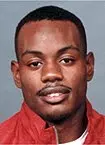
Davis Sets Sights on NCAAs, 2000 Olympics
June 21, 1999 | Track & Field
April 27, 1999
By Chris Huston
Sports Information Student Assistant
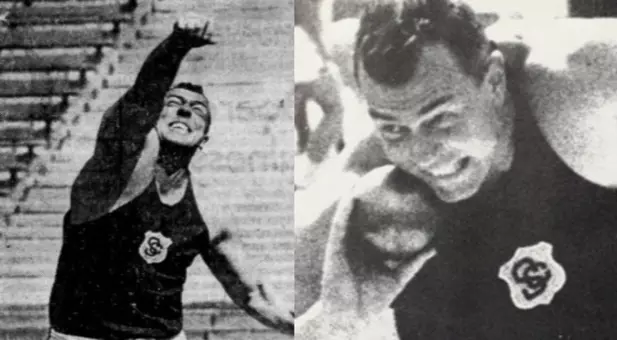
No matter where Jerome Davis goes, he is reminded of "The Legacy." When he stops by the USC track and field office, he sees the championship trophies and the All-American plaques. As he strolls through Heritage Hall, the marble faces of past legends stare back at him. Three Olympic gold medal winners accompany him on the cover of this year's USC track and field media guide. Even when the 21-year-old gerontology major spends time at a retirement home on Central Avenue, he can't escape reminders of Los Angeles' glorious track and field history.
"Some of the folks there told me how big track used to be in this town," said Davis, the defending NCAA 400-meter champion. "The old Coliseum Relays were huge. The stadium used to be packed with people coming out just to see track."
It's not hard to see why Davis wants to extend that legacy. To be mentioned in the same breath as past Olympians is quite an honor. Eventually, Davis wants to join them on the victory stand.
He can already picture his victory lap.
The setting is Sydney, Australia. A sold-out Olympic Stadium cheering wildly as he trots briskly around the track waving a huge American flag given to him by an onlooker. He has just won the gold medal in the 400-meter dash. A world-record has fallen by the wayside.
Jerome Davis can picture this because he's already done it. In 1996, to be exact.
That was the year he captained the USA Junior Team that competed in Sydney at the World Junior Championships. Jerome won two gold medals and a silver. And yes, he ran his victory lap. The thought of returning to Sydney has been on his mind ever since.
"I told the Australian press afterwards that it would be great to be back in 2000," said Davis, laughing.
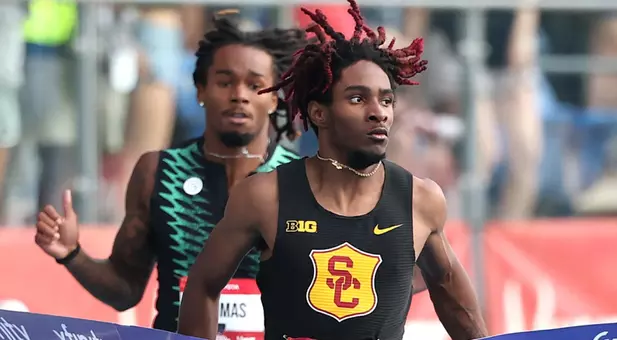
But his first order of business is to help the Trojans capture their first NCAA title since 1977. With the help of USC Director of Track and Field Ron Allice, Davis is ready to lead the way. He is already a three-time Pacific-10 Conference champion and seeks to become the league's first athlete ever to win four consecutive 400-meter titles. Davis credits much of his development to his relationship with Allice.
"When I first arrived at USC, we didn't get along that well," Davis said. "I thought that I didn't need any coaching because I'd been running since the third grade. It was a tough transition for me from high school to college. As a freshman, I thought I knew more than I did. Now we have the type of relationship where I can just ask, 'What do you think about this?' or 'What do you think about that?' He has really taught me a lot, and he has helped me to realize my ability."
As a USA Today All-American at Burroughs High School in Ridgecrest, Calif., Davis' ability caught the attention of colleges everywhere. He almost chose to attend Arkansas, but the desire to stay close to his family brought him to USC. Tragically, his older brother Eddie died of stomach cancer after Jerome's senior year.
"My brother was a great person," Davis said. "He was also a very good athlete and an excellent basketball player who could have played professionally. Sometimes I have this ritual before a race where I'll say a little prayer and then say 'Let's go Eddie . . . it's show-time.' People also ask me about the chain I wear around my neck with the letter "E" on it. That was Eddie's chain."
In 1996, not long after losing his brother, Davis won his first Pac-10 400-meter title. He had started that season slowly, but as is often the case when he races, he finished strong. Allice learned something that year: never count out Jerome Davis.
"Jerome has all the intangibles needed to be a champion," Allice said. "For him to be a three-time Pac-10 champion is a testament to his heart and determination. He is a very grounded young man who likes to compete. He likes the challenge of taking someone on, and he wants to be the guy to fight for those last 20 meters. You should never underestimate him. On a scale from one to 10, he's a 10."
Davis' dominance in the 400 meters is remarkable given the number of great athletes who compete in the event. But even after defeating elite sprinter Tyree Washington at the 1998 Mt. SAC Relays, few expected a national title could be in the works. So when Davis came from behind to beat Miami's Davian Clarke at the 1998 NCAA Outdoor Championships in Buffalo, N.Y., it was a surprise to many. Davis likes to be out of the spotlight. He knows that his low-key approach can work to his advantage.
"My approach to a race is to run within myself, stay relaxed, and not get caught up with the other runners," he said. "It's all about the clock."
As the Trojans approach the end of the 1999 track and field season, no one is underestimating their chances of winning the Pac-10 title, or even the school's 29th NCAA team championship. But first, they have some business to take care of with their crosstown rivals. The Bruins have won 20 straight dual meets against Troy, though some are saying that 1999 is the year that USC will finally bring home the victory.
"We talk about that streak a lot," Davis said. "I'd love to be a part of the team that finally beats them. A lot of people are projecting us to win, but it's all just numbers. I know, realistically, that it's going to come down to the 4x400 relay for us to beat them. It'll go down to the wire.
"As for the Pac-10 and NCAAs, we just need to stay healthy and keep our heads level," he says. "We can't get caught up in the hype."
Jerome Davis won't get caught up in the hype. He has his feet on the ground. But sometimes, when he's with the folks down on Central Avenue, he wonders: What will they say about me when I'm old?
He knows.
"I want them to say that he came to USC and did something no other athlete has ever done.
"And that he was a true Trojan."